
America's non-violent future
Plus: Trends in (pot/booze/cigarette/opioid) addiction

[Decompressing after travel—I hope to get back to regular blogging before long. A belated congratulations to Knicks fans, as their 1970 championship was the first one I remember watching. As a Bucks fan I feel a connection—we won in 1971 and then also had a 50-year wait for another title.]
Part 1: Apart from the 2020 surge in murders, a period when police sort of gave up on crime for a brief period, the US murder rate has been declining since 1991. I expect this decline will continue, and within about 20 years the US will have Canadian rates of murder. More specifically, we’ll have a murder rate close to the current Canadian rate of roughly 2 per 100,000 people. I anticipate that the Canadian rate will also decline further and thus remain below US levels in 2046.
In the US, the murder rate peaked at 10.7 per 100,000 in 1991 and fell to only 4.29 per 100,000 in 2025. Early figures suggest that 2026 is on pace for a rate of roughly 3.8 per 100,000. (And no, it’s not due to better medical care.)
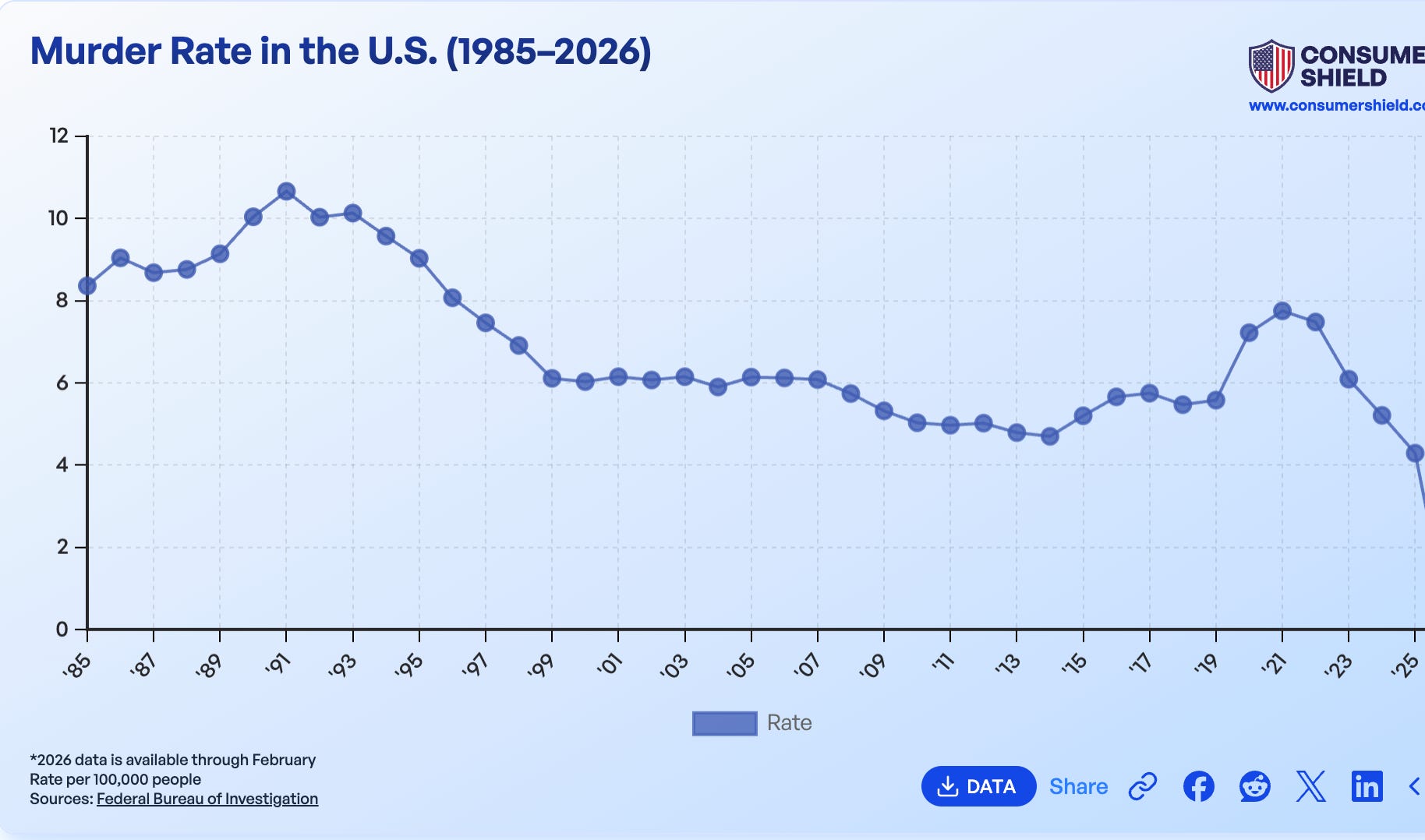
While the data from early American history is rather fuzzy, I suspect this is the lowest rate in US history (based on some highly scientific analysis on my part—watching lots of gunslinger movies as a kid.) Seriously, I expect the rate will go much lower, for at least four reasons:
The level of births was 4.32 million in 2007, and has been falling ever since. That means the number of 19-year old Americans is virtually certain to fall sharply over the next 20 years. And young men are especially likely to be involved in violent crime. Also note that the fertility rate of African Americans is falling especially rapidly and is now below the rate for white Americans.
Declining crime tends to feed on itself. With fewer murders, each crime stands out more and attracts more police attention. That leads to a greater chance of being apprehended, further discouraging crime.
The sort of surveillance technology that has radically reduced crime in Chinese cities like Shenzhen is likely to eventually become a feature of American cities. Artificial intelligence will play a role, as will ubiquitous cameras in public spaces, the tracing of location via cell phones, automobile computers, and related technologies, as well as better DNA testing. Robocops will patrol our streets. The world of 1984 is arriving faster than I expected. Big Brother will be watching us all in 2046.
The sort of lifestyle changes that have reduced fertility rates are also likely to reduce crime rates. When I was young, bored young men stood around on street corners, which is a recipe for crime. Now they can enjoy all sorts of electronic entertainment in the comfort of their home. These forms of entertainment also increase the cost of incarceration, where Netflix may not be available. Alcohol use is declining and being partially replaced by pot use, which is less likely to provoke violence.
If you believe that my claim is far-fetched, consider that just a single factor—demographics—is likely to reduce crime committed by young men by roughly 15% to 20% by 2046. That alone would get the murder rate down from the 2026 estimated 3.8 to roughly 3.2 per 100,000. And as recently as 2021, the rate was 7.75 per 100,000. Much of the progress toward Canada’s (current) murder rate has already occurred, even though America still has about hundred gazillion guns. (By the way, I’m not a gun nut—some restrictions may be sensible—just saying that guns are not the primary factor.)
I haven’t even discussed immigration, which clearly plays a role in the especially rapid decline in murder rates in places like NYC.
To be clear, I’m not suggesting that a rate of even 2 per 100,000 is ideal—many European countries have rates of 1 per 100,000, or even less. But it would represent a dramatic reduction from the rate of nearly 10 per 100,000 during much of the 1970s and 1980s. Speaking of 2046, who can forget this gorgeous Wong Kar Wai film:

Part 2: I cannot prove this, but I strongly suspect that drug addiction in America is on the way down. Here are my claims; you tell me if I’m mistaken:
There is less alcoholism than in the past
Smoking is declining fairly dramatically
Opioid drug abuse is declining
Marijuana abuse is increasing
Now I’d like you to consider two different social science hypotheses and tell me which one better fits the data:
Pot is a “gateway drug”, which leads to even more harmful forms of drug abuse.
Pot is a substitute for other types of drugs, and legalizing pot would tend to reduce other (more serious) forms of drug abuse.
Behind the paywall, I’ll offer a few thoughts on the War on Drug Using Americans:
