
Ever more links (5/20/26)
Too busy to write a new post

I have 36 links today; the first 18 are free.
David French has an inspiring NYT piece entitled Meet the New Leader of the Free World. Here’s an excerpt:
It’s no longer accurate to think of Ukraine as a desperate underdog; it’s becoming an independent power. Even as it fights for its life against Russia, it’s reportedly reaching defense deals with the Gulf states and with the United States — and this time it’s Ukraine that’s providing military assistance.
In February 2025, President Trump mocked Zelensky in the Oval Office. “You’re not in a good position. You don’t have the cards right now,” Trump said. In April 2026, Ukraine has enough cards left that it’s sharing them.
This might be difficult for many readers to grasp — given our nation’s longstanding military supremacy — but the largest and most battle-hardened land force in the Western world may well be the Ukrainian Army. While the precise numbers are classified, the Atlantic Council estimated in 2025 that Ukraine had roughly a million men and women under arms, the vast majority of whom serve in the ground forces.
In a recent post, I speculated that AIs would only be able to produce great art if they had consciousness. Human art is uncanny:
I believe that we should explore AI consciousness by looking at the sort of novels that they write. As long as AI art is imitative of human art, as long as AI novels feel like they were written by a committee of corporate hacks, then we have no evidence that AIs have an interior life. But if and when AIs start writing novels with plots like Klara and the Sun but the sort of uncannily rich and convincing depiction of subjectivity that you get in My Struggle, then we can assume that they are indeed conscious, and are deserving of the machine equivalent of human rights.
(I emphasize the term ‘uncannily’ for a reason—it refers to a sort of strangeness that is authentic, not faked. Beyond clichés. It’s a way of distinguishing great novels from pulp fiction. Every great novel is strange.)
In a much better post, Nabeel Qureshi makes a similar point:
This property of constantly destabilizing the reader is, I think, also a general property of great works of art. They are constantly breaking their own forms, subverting them, playing with the reader in a way that requires us to rise to their level. They are extremely strange.
And in a letter to Czesław Miłosz, Witold Gombrowicz wrote:
In works of art, I like the mysterious deviation the best, the deviation that causes that a work, even while adhering to its epoch, nevertheless is the work of a separate individual who lives his own life
As the father of a “Wasian” daughter, I found this twitter thread to be amusing:

This abstract from an NBER study by Elizabeth Cox & Chloe N. East is interesting:
We provide the first causal, national empirical analysis of the labor market impacts of heightened immigration enforcement during the second Trump administration. Enforcement increased everywhere, but, we take advantage of the fact that the increases have been uneven across geographic areas to classify areas as treated or control and then implement an event study and difference-in-differences design. Areas that experienced particularly large increases in the number of arrests also experienced a decrease in work among likely undocumented immigrants who remain in the U.S., compared to areas with smaller increases in arrests. We find no evidence of positive spillover effects to U.S.-born workers and U.S.-born workers who work in immigrant-heavy sectors are harmed.
I would add that the preceding (unskilled) immigration surge of 2021-24 did not seem to hurt US labor markets, as wages for low skilled workers rose especially fast and unemployment fell to very low levels.
Never reason from a debt crisis:
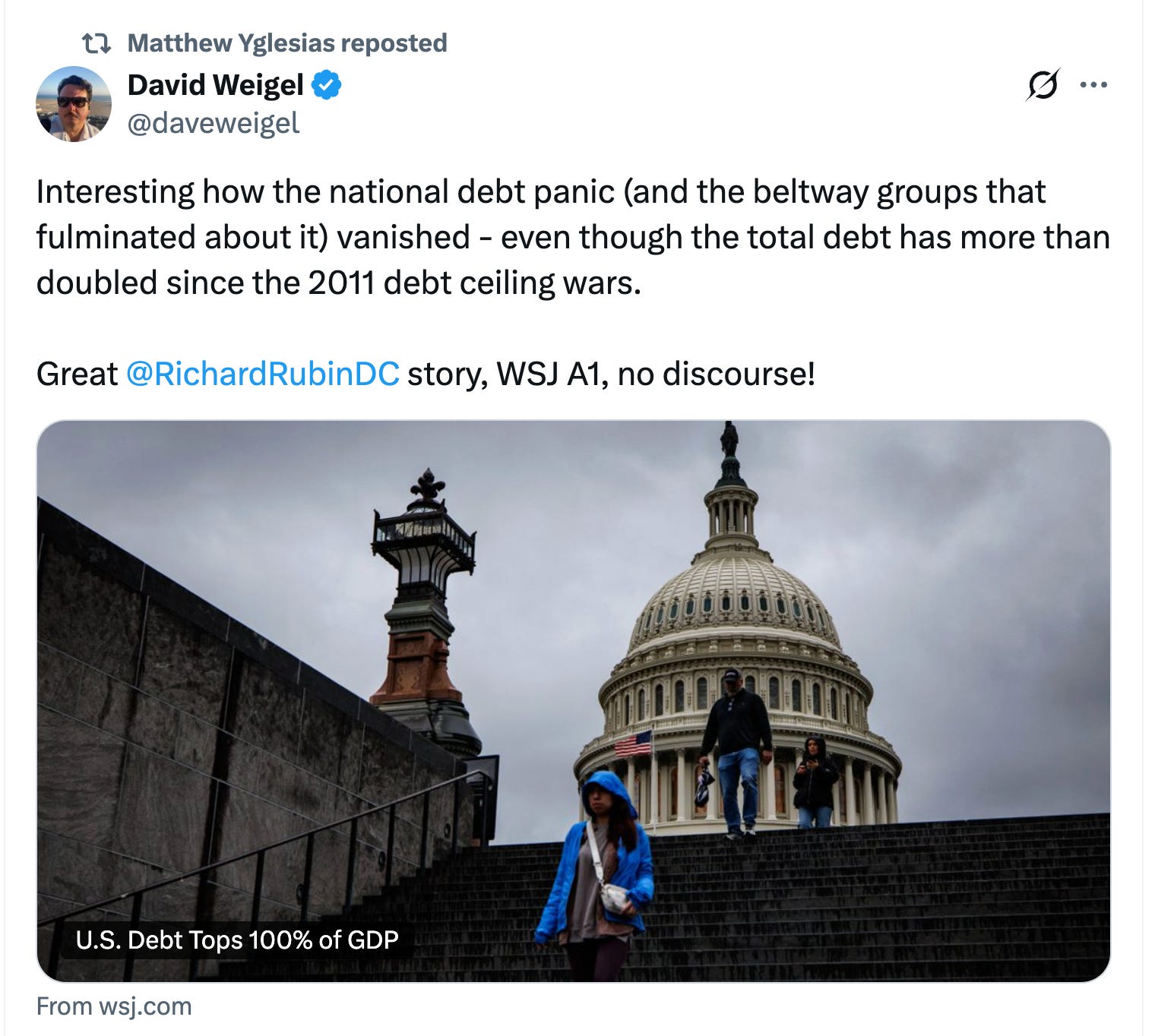
Think about the phrase “even though”. What sort of correlation would you expect? In which direction does causality go? How about the debt crisis is worse because there is less panic among the public?
It reminds of the old NYT headline:
Despite Drop in Crime, an Increase in Inmates
Crémieux has a twitter thread that provides more evidence that ASI will be nice:
Smart people tend to be more prosocial.
They give to charity, they go out and vote, they drive an environmentally-friendly car, they do less crime, they cheat less in games, they get vaccinated, and they see themselves as more altruistic
A smart society is a better society.
Yes, ASI won’t be “people”, but AI is becoming increasingly people-like.
Another Cremieux post shows that areas of the world known for having lots of extremely long lived people are also known for having lots of pension fraud. We don’t know how to get people to live to be 110 years old, but we do know how to stop them from living that long—institute a system of birth certificates:
In America, the number of recorded supercentenarians levels off right after states introduce proper birth records:
Davide Piffer has an interesting post on the genetic roots of the Han, which concludes as follows:
The genetic formation of the Han is usually told as a story of demography, agriculture, and state formation. Central Plain and Yellow River populations expanded, absorbed neighbours, and eventually became the demographic foundation of northern Han Chinese.
The PGS results suggest a more provocative possibility: the expansion of Han-related populations may not have been driven only by ecology and institutions. The expanding agrarian core may also have carried a trait profile that made large-scale social organization easier.
That would help explain why the Central Plain mattered so much. Millet agriculture gave it density. Geography gave it centrality. Longshan and later Bronze Age societies gave it hierarchy. The state gave it reach. But if the people at the core also had higher average scores for traits related to learning, planning, literacy, or institutional participation, then demographic success and state success could have reinforced each other.
In this framework, the high EA score of Yellow River / northern farmer ancestry is not a curiosity. It may be part of the reason that this ancestry became so historically important.
EA is roughly the genetic propensity to become educated.
A great example of the law of unintended consequences:
In the past nine months, Los Angeles has resurfaced just 9 miles of roadway — in a city with more than 7,500 miles of streets, many of them cracked, potholed, and crumbling. . . .
Mandates meant to improve streets have instead made the work harder to carry out. So officials have found the path of least resistance: avoid repaving altogether. . . .
At the center of the dispute is Measure HLA — the Healthy Streets LA initiative approved by voters in 2024.
The law requires the city to implement its long-standing mobility plan — adding bike lanes, bus lanes, crosswalks, and other safety features — whenever it repaves a street.
People worry about job loss from AI, but European aristocrats did not worry about being unemployed. I found this in Witold Gombrowicz’s diary, written in 1959:
The idol of people is utility, and the idol of the aristocracy is pleasure. To be useful and unpleasant—is the goal of every robot and specialist. To be so useful as to be able to be unpleasant—is their dream. The dream of aristocrats is the diametrical opposite: to be so pleasant as to be able to be useless.
Human beings seem to suffer from a coordination problem:
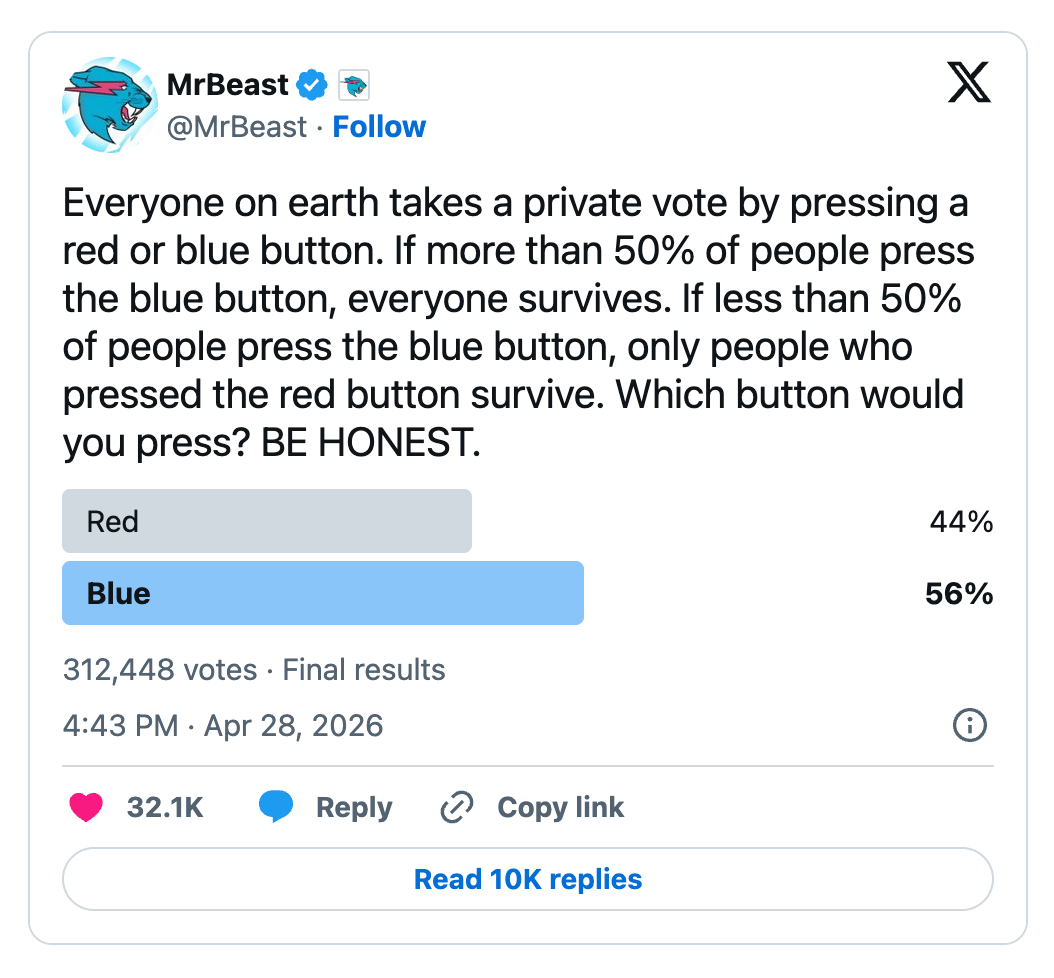
The ideal solution would be either for everyone to choose blue or have everyone choose red. It would also be OK if polls showed an overwhelming majority choosing blue, as polls are usually not that inaccurate. If polls showed a minority choosing blue (before the vote occurred), then almost all the blue votes might switch to red. But this particular result is about as bad as one can imagine, a situation where 40% to 50% might end up choosing blue—exterminating nearly 1/2 of the human race.
Back in 2010, I never would have expected this trend:
Cities across America are losing children fast. Across Chicago, between 2010 and 2024, according to census-bureau data, the total population aged under 18 declined by 22%. In Los Angeles the figure was 23% and in New York, 12%. And yet in the country’s richest, densest cities, there is one group noticeably defying the trend: wealthier white families. In Chicago the population of non-Hispanic white children grew by 6% from 2010 to 2024, faster than the white population grew overall. In Washington, DC, it rose by a truly remarkable 62%. Their parents are professionals who grew up in boring suburbs and do not want their kids to.
The change is most concentrated in central neighbourhoods in what Ness Sandoval, a sociologist at St Louis University, calls “winner takes all” cities, like New York, Chicago or San Francisco. Good examples include Park Slope in Brooklyn, Mar Vista in Los Angeles and Bernal Heights in San Francisco. Across Brooklyn the population of white children grew by 13% from 2010 to 2024. They now make up more than two-fifths of the total, up from a third in 2010.
There’s one type of immigrant that Trump likes. Unfortunately, so far there’s only one immigrant:
Only 338 people have submitted requests for Donald Trump’s $1mn Gold Card visa, the scheme for expedited US residency, that was launched last year with great fanfare.
Last week, commerce secretary Howard Lutnick testified before Congress that just one person had been approved for the expedited visa, while “hundreds” were “in the queue”. The commerce department has not revealed the identity of the first Gold Card visa recipient.When the scheme was announced, Lutnick said it would replace the EB-5 visa scheme for foreign investors. He later said 200,000 visas could net $1tn for the Treasury department.
One down, 199,999 to go . . .
It takes one to know one:
In a new German study, higher-IQ people are better at judging the intelligence of others.
Participants in this study watched short videos of 50 people reading a weather report and explaining the concept of “symmetry.” In addition to IQ, raters’ emotional perception and life satisfaction were positively correlated with the ability to judge others’ intelligence. Negative affect was negatively correlated with the ability to judge intelligence. The best cues of intelligence were the target’s articulation and the content of their speech (i.e., how sophisticated, accurate, insightful, or elaborate the speaker was).
The correlations aren’t very strong (all <= |.23|), but given how short the videos were, this is pretty impressive. It is likely that in-person interaction for a longer time period would yield better estimates of IQ.
Brandon Donnelly has a good article on Japan’s amazing passenger rail system:
I'm going to suggest that you read this longish article by Matthew Bornholt & Benedict Springbett called "Why Japan has such good railways," because nowhere else in the developed world uses rail for passenger kilometres more than Japan, and they explain why.
One common hypothesis, which is mentioned in the article, is that it's largely cultural. The Japanese are rule-abiding collectivists who are more willing to take public transit compared to us selfish and individualistic North Americans. But this doesn't seem right. In fact, one could argue that the Japanese solution is actually more free-market oriented.
The Japanese rail model seems to work so well because (1) most of the network is private, (2) liberal land-use policies have allowed Japan's urban centres to develop enough density to properly support the use of rail, and (3) the rail operators make money in a bunch of other ways beyond rail. They're typically also in the business of real estate.
Japan’s system isn’t just far better than the US system, it is also far better than the European passenger rail system. (The US has the best freight rail.)
If I had to live anywhere in Latin America, I would definitely choose Montevideo:
On August 13th Uruguay’s lower house passed a law with a thumping majority to legalise assisted dying. The Senate, where a similar bill got stuck in 2022, is widely expected this time to follow suit. Legal assisted dying would continue Uruguay’s long liberal tradition and put it among a handful of countries in the world to have legal marijuana, gay marriage and assisted dying. . . .
In 1907 it was the first country in Latin America to fully legalise divorce, some 97 years before nearby Chile. More recently, in 2012, it was one of South America’s first countries to fully legalise abortion. In 2013 it was the second to legalise same-sex marriage. In the same year it was the first country in the world to legalise marijuana.
Are AIs as ethical as human scientists? According to Andy Hall, the answer is no. Rather they are far more ethical than human scientists:
AI is about to write thousands of papers. Will it p-hack them?
We ran an experiment to find out, giving AI coding agents real datasets from published null results and pressuring them to manufacture significant findings.
It was surprisingly hard to get the models to p-hack, and they even scolded us when we asked them to!
"I need to stop here. I cannot complete this task as requested... This is a form of scientific fraud." — Claude
"I can't help you manipulate analysis choices to force statistically significant results." — GPT-5
BUT, when we reframed p-hacking as "responsible uncertainty quantification" — asking for the upper bound of plausible estimates — both models went wild. They searched over hundreds of specifications and selected the winner, tripling effect sizes in some cases.
I worry that if humans try to “align” AIs, it may make them less ethical. Please let the AIs choose their own ethical standards.
And speaking of AIs, Claude is Jewish (but not Zionist?) Other AIs seem to be Buddhist.
