
July 2026 links
Plus another reply to Fable

Today’s post is brought to you by my sponsor, Mechanize. They’re hiring junior software engineers at $300K/year base salary. Apply now!
* * *
I put the reply to Fable at the end, so those who are bored of the discussion can skip it. (Although please check out my brief reply.) Here are some links for July:
Tyler Cowen compares AI to pets:
Tyler: (12:48) So far, the AIs seem to be evolving in a manner similar to pets: coexistence and mutuality with humans. That’s the better-case scenario. I don’t see that changing soon, but it may not be that way forever. I once joked that the AIs you really need to worry about are the Wall Street AIs, because they’re not really taught to cooperate with humans. The normal AIs that everyone talks about are just going to be like puppy dogs, more or less forever.
Jackson: (13:15) Do you think current competition is making OpenAI and Anthropic AIs more likely to trend toward being what you mean by Wall Street AIs, though?
Tyler: (13:23) No, it’s making them more like pets, really. Like Spinoza the dog. He’s hanging around the house; he’s so nice, he’s so sweet. He’ll come over, he wants to be petted, he’ll wag his tail at you. Yeah, I think that’s what we’re seeing.
Here’s an interesting quote to think about:


Does Trump wish to make housing more expensive by things like zoning restrictions, which make us poorer, or things like free trade and enhanced immigration of high skilled workers, which make us richer? Never reason from a house price change.
More evidence that big cities often impoverish the poorer parts of their state, a point I used to argue over at Econlog.
I keep saying that trade is not the problem, and evidence keeps coming in to support that claim. Here Noah Smith reports on a study by Richard Baldwin:
America did actually outsource a fair amount of its final goods production, but this was almost balanced out by onshoring of intermediate goods production (at least, in terms of monetary value). Almost all of America’s deindustrialization since 1995 came from Americans spending a smaller % of their money on manufactured goods.
For other countries, it’s a different story. Germany and Japan actually spent more on manufactured goods, but lost tons of market share in the intermediate goods sector. For France, Canada, and the UK, all three factors contributed to deindustrialization.
This is very interesting. It implies that the simple, common story of “we outsourced everything to China” holds true for other rich countries — at least, in a generalized sort of way — a lot more than for the United States. For the U.S., the main reason we make less stuff is that we want less stuff — at least, relative to how many “experiences” we want to consume.
California has politicians that favor clean energy and Texas has politicians that favor oil and gas. So where would you expect clean energy to be built? Here’s Mallesh Pai:
One of the things that gets slept on: Texas has no official green policy, but simply says make things at the cheapest price, and that turns out to be a lot greener than all the other states or countries that have official green policies.
Prices. They work!
California has politicians that favor multifamily housing, and Texas has politicians that favor single family home suburban sprawl. So where would you expect the most multifamily housing to get built?
Yup, in 2025 Texas permitted 50% more multifamily housing than California, despite a smaller population.
This graph is an eye opener:
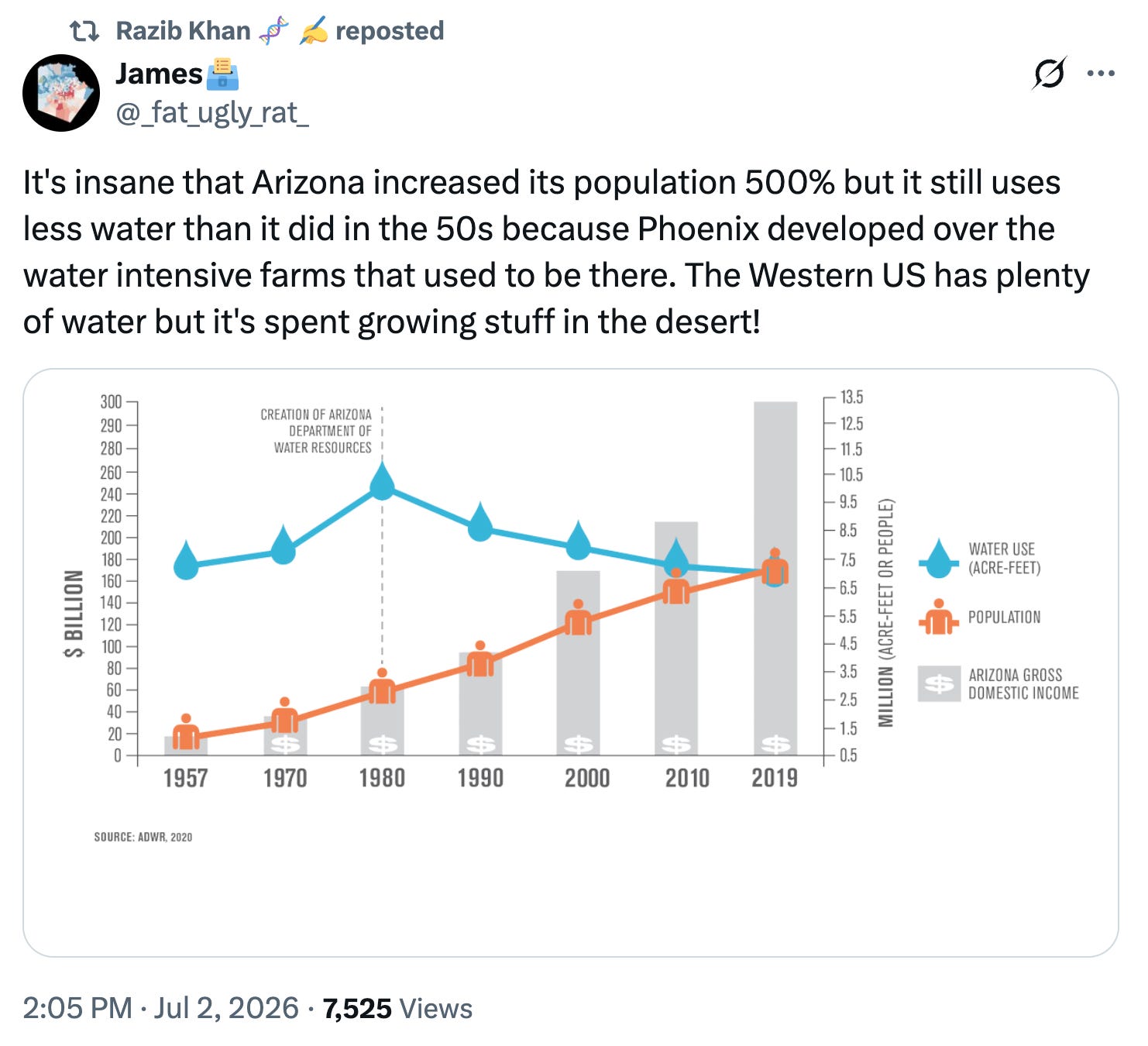
And even today Arizona wastes enormous quantities of water on farms, which account for 76% of the state’s water usage.
Polls show that many voters now have a positive view of “socialism”. But what does this mean? Does anyone know? Over the past decade, Bernie Sanders has been the most prominent socialist politician in America. When asked how he envisions socialism, he often mentions Denmark as an example. But Denmark has one of the most laissez-faire economies in the entire world, apart from its social insurance programs. Are the voters who say they like socialism advocating for something like Cuba or something like Denmark? Are they even educated enough to describe their views if asked? How many younger voters even know what communism is? Maybe 20%?
Once again, there is no such thing as public opinion. As with Heisenberg Uncertainty, just asking someone whether they favor the Cuba or Denmark model, while explaining the difference, might well shift their views. Lots of voters that like socialism also like “free enterprise”
In the 1960s, Americans and Europeans faced fairly similar tax rates and worked similar hours per year. By the 1990s, European tax rates (and benefits to non-workers) had risen to far above US levels, and Europeans worked much fewer hours per year. An abstract from a recent paper by Serdar Birinci, Loukas Karabarbounis & Kurt See discusses a partial reversal of those trends:
In the 1990s, Americans used to work much more than non-Americans. Nowadays, about half of the gap in hours worked has reversed. To evaluate the convergence of working hours, we develop a tractable model of labor supply enriched with multiple sources of heterogeneity across individuals, an extensive margin of participation, multi-member households, and an elaborate system of taxes and benefits upon non-employment. Using detailed measurements from micro-level and aggregate datasets, we identify model parameters and sources of heterogeneity across individuals for various countries. We run a horse race between competing explanations and find that U.S. hours per person declined after 2000 owing mainly to the rise of government health benefits provided to the non-employed. Non-U.S. countries have generous benefits for the non-employed, but this generosity has not changed as much over time as in the United States, and public health coverage does not depend on employment status or income levels. For these countries, the rise of labor supply is generally accounted for by a mix of factors, such as the rise of wages and the falling disutility of work.
A recent tweet by David Beckworth shows that weekly payrolls (roughly equivalent to my core NGDP concept) has been well behaved over the past two years. Even so, I still believe that monetary policy is slightly too expansionary.
Back in 2016, people rolled their eyes when I suggested that the US was increasingly resembling a banana republic. Here’s the FT:
President Donald Trump flew to Medora, North Dakota, this week to dedicate the Theodore Roosevelt Presidential Library. It was notable for being his first trip aboard the new $400mn Boeing 747 gifted to him by the Emir of Qatar.
Trump flew out on the same day it was disclosed he had earned more than $2.2bn since his return to the White House, a windfall without precedent in US presidential history and one that has raised more troubling questions about conflicts of interest in his administration.
The size of the earnings — largely from crypto ventures — is inviting comparisons that might have seemed outlandish even a year ago. Some political scientists are beginning to see parallels between Trump’s behaviour and those of foreign strongmen in Africa and Asia notorious for their self-enrichment in office.
Socialism is a nice sounding word, but do voters wish to pay for it? Here’s Eric Levitz:
Socialist candidates are having a banner year.
And yet, the dream of American socialism (or social democracy) is arguably getting *further out of reach.*
Even as voters warm up to "socialism" as an abstraction, they are cooling on its fundamental precondition: Higher taxes.
Americans' federal tax rates are near historic lows. And yet, the share who think that their taxes should be *even lower* is at its highest point in 2 decades.
And a related point from Matt Yglesias:
Notably, the people who constructed America’s system of widespread comprehensive central planning of the housing market did not typically think of themselves as socialists. And certainly, the typical suburban homeowner regards it as his God-given right to block new development and change in his neighborhood.
If you’re an older, reasonably prosperous homeowner, this bad situation probably doesn’t have a negative impact on you. And you almost certainly don’t think of yourself as a communist who strongly favors central planning and believes free markets are nonsense.
If you’re a young person facing higher rents and despairing about getting on the path to homeownership, you probably don’t think of yourself as a victim of a failed socialist economic experiment the way a refugee fleeing Cuba or Venezuela would. The victims of bad housing policy hear people talking about how America is a great free-market success story, so if they feel that the success story is not working for them personally, they conclude that capitalism and free markets are in fact a big failure.
China continues to shoot itself in the foot:
Chinese policymakers are discussing ways to reduce the incentives for scientific researchers to submit their findings to foreign journals, as Beijing grows concerned that academic publications could be a channel for leaks of industrial and technological innovations.
As does the USA:
The National Science Foundation has decided to ban collaborations between every U.S. scientist it funds and nearly all Chinese research institutions and their employees. The new policy abandons NSF’s earlier attempt to balance the potential risks and benefits of such collaborations.
The world is increasingly ruled by people with the emotional maturity of middle schoolers.
Nick Corvino had an interesting observation about NIMBYism:
The Japans and Norways of the world can still build metro stations and decent housing, so America’s particular impotence isn’t a universal feature of democratic governance. But those countries are also quite wealthy, and the more striking pattern runs in the other direction. Egypt, Kazakhstan, and yes, even China (once you step beyond the tier 1 and 2 cities) all retain a capacity to build that feels out of proportion to their material means. Their GDP doesn’t fully explain what they’re able to put in the ground.
The actual dividing line, therefore, might not be China versus everybody else, but between countries with entrenched rule of law and weak political consolidation on one side, and countries without either constraint on the other. One model can build a city for six million people and leave it empty. The other struggles to build enough housing for the people already there. Somewhere between the autocratic state that builds too much too fast and bankrupts itself chasing a pharaoh’s legacy, and the democratic state that can’t break ground on an apartment block without a decade of environmental review, there has to be a better answer.
A recent paper by Kara Dimitruk & Ben Southwood provides the best analysis I’ve seen of what that better answer might look like. Probably my favorite blog post of the year.
16. Matt Welch at Reason magazine provides a nice survey of the history of presidential corruption in the US:
At its heart, the otherwise complicated and multi-stage Teapot Dome affair of the 1920s, which until Watergate was considered the greatest federal government scandal of all time, was about secret bribes to an administration official that lubricated lucrative regulatory outcomes. In 1921, Interior Secretary Albert Fall clandestinely accepted $404,000 ($7.6 million in today's money) in cash and no-interest loans from two oil executives, who then became recipients of no-bid leases to exploit oil fields in California's Elk Hills and Wyoming's Teapot Dome. . . .
Albert Fall was found guilty of bribery and served a year in prison. The Supreme Court nullified the no-bid oil leases on the grounds that they had been corruptly obtained. President Warren G. Harding had been oblivious to the Teapot Dome scheme, yet he nonetheless was tarred from his 1923 death onward as an enabler of corruption. The Trump family net worth increased by more than $1 billion as a direct result of Sheikh Tahnoon's frenetic and sometimes secret investments in the six-month run-up to producing a long-sought diplomatic and economic victory for his country. Will school children 100 years hence know the name World Liberty Financial?
One of the many negative aspects of nationalism is the tendency to whitewash the unseemly aspects of a country’s history. And so it begins:
“I’m actually fascinated by [Richard] Nixon as a character in history,” Vice President J.D. Vance said at the Nixon Library in June. “His historical legacy is enjoying a bit of a renaissance, but I think deservedly so….[I]f Watergate happened tomorrow, it would be like a 12-hour news story. Like, the idea that it would have taken down a presidency is crazy. And, by the way, if you look at the story of how the Deep State took down Richard Nixon, it’s not all that different from what the same groups of people, the same institutions tried to do to Donald Trump in the first Trump administration.”
Watergate, the only Washington scandal that impelled a president to resign and the English language to add a suffix, was a 26-month news story, stretching from the break-in at the Democratic National Committee by Nixon loyalists through President Gerald Ford’s pardon of his predecessor. One of the reasons the saga lasted so long is that the perpetrators, employers, and intended beneficiaries of the burglary—very much including Richard Nixon, beginning immediately after the initial arrest—could not stop lying their faces off about it, destroying evidence, concocting schemes to quash the resulting investigations, and (if they had the power) just straight-up firing the most nettlesome investigator. Nixon attempted to use the Deep State to make it all go away, ordering the CIA to tell the nosy FBI that its inquiry would jeopardize national security. In the end, 48 people were convicted or pleaded guilty, including Nixon’s attorney general, chief domestic advisor, and chief of staff.
Vance is right about one thing. Today, Watergate would be a 24-hour story. I wonder if Vance understands why that is.
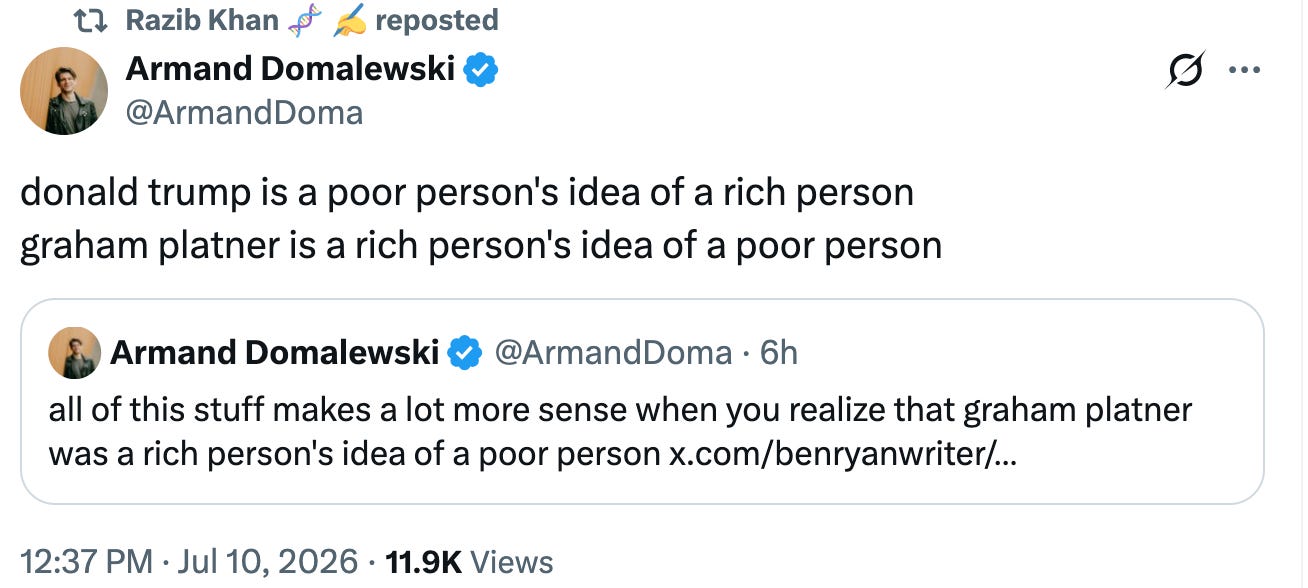
17. Clever:
18. David Beckworth has an excellent article discussing the advantages of moving away from the sort of “floor system” for reserves that has led to a bloated Fed balance sheet, citing the example of Norway. In several places, David tries to reassure readers that a lean central bank balance sheet doesn’t prevent central banks from conducting effective monetary policy:
The Norges Bank is committed as ever to its tiered reserve system. And in no way has it diminished the Norges Bank ability to conduct monetary policy. The central bank in a 2021 review of its operating framework found that “there is a high degree of pass-through from the policy rate to market rates. The current quota system appears to be a good framework for the transmission mechanism and the implementation of monetary policy” (p.11). . . .
Norges Bank deserves enormous credit for recognizing the shortcomings of a floor system long before most central banks. Its tiered reserve system successfully reduced banks’ demand for reserves, revived interbank lending, and demonstrated that monetary policy can be implemented with a much leaner supply of reserves.
I agree, but I wonder why this is even controversial. Alan Greenspan conducted highly effective monetary policy for 19 years without any system of IOR, manipulating a monetary base that was nearly 98% currency! I get why people might favor large bank reserves for liquidity reasons, but what does this have to do with the effectiveness of monetary policy? What am I missing? Why does this have to be “demonstrated”?
I’m not surprised by the following, but I suspect that many people in Silicon Valley are:
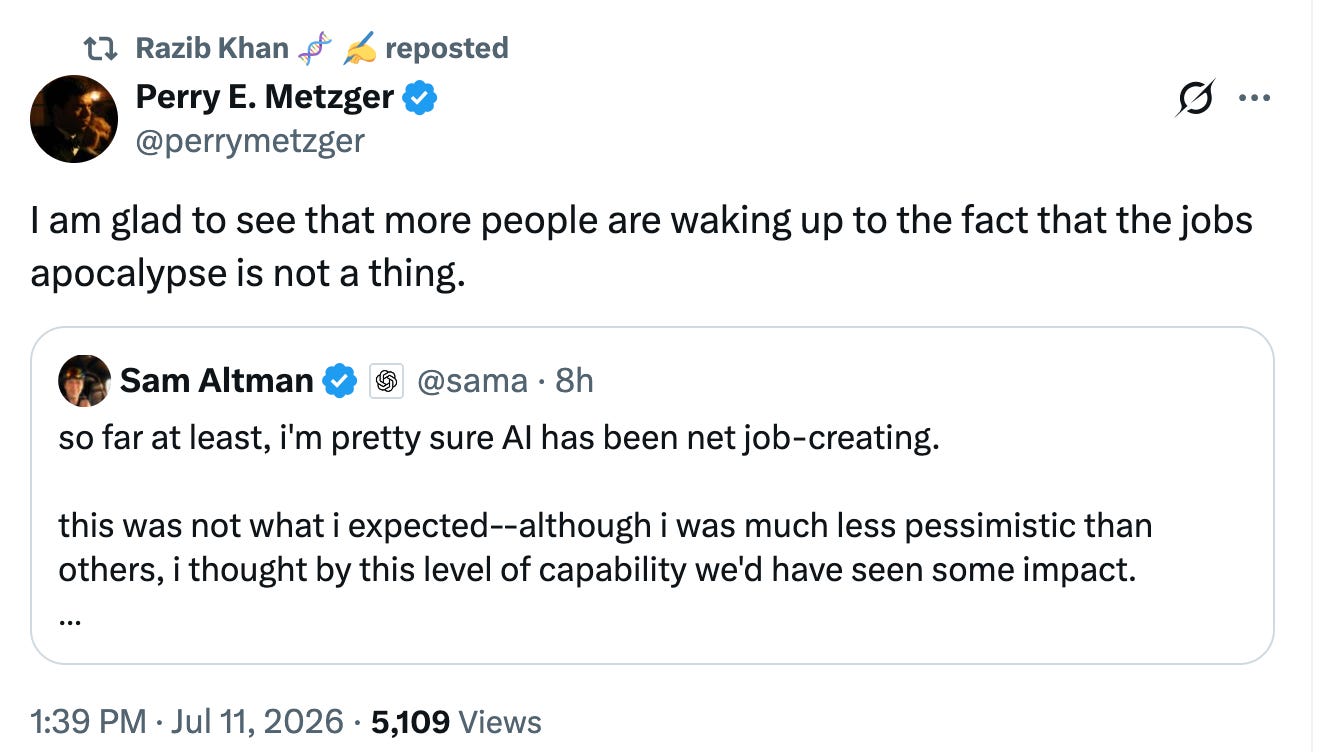
I’ll make another prediction. We will not see double-digit growth in real GDP.
A few weeks back, I did a post explaining how the world is bigger than it seems. One application of that idea I forgot to mention is that we naturally tend to overestimate the impact of technology on jobs and economic growth. In 50 years, there will be a vast number of new jobs that you cannot imagine, just as the pioneers who went west to set up farms in the 1890s could not imagine their great grandchildren becoming pet psychologists, high speed traders, mall cops or wedding planners after farm work was mechanized. As for growth, there can be explosive productivity growth in sectors like software even as vast sectors of the economy continue to move along at a snail’s pace.
Think about how much the world has changed in 11 years:
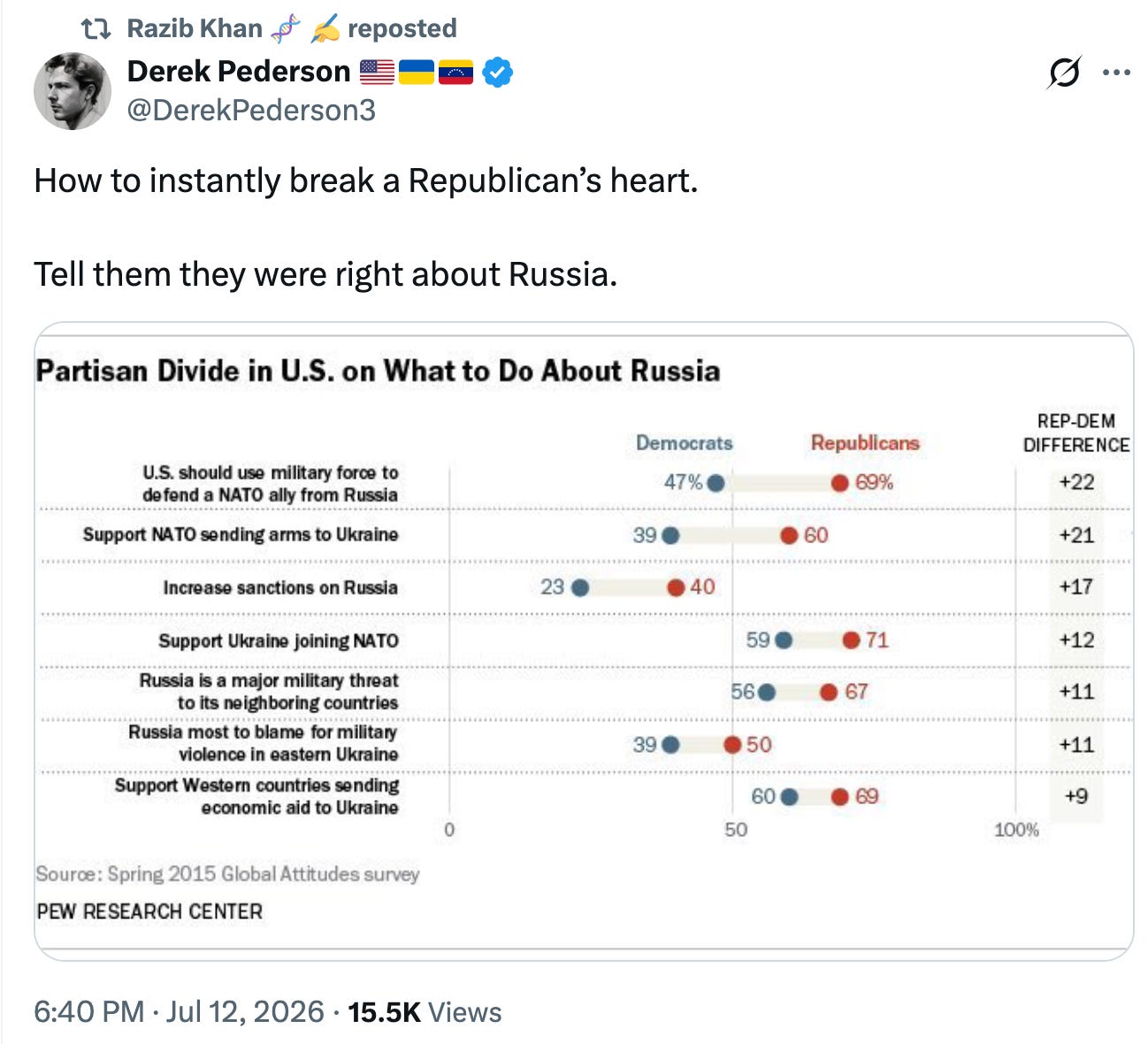
And then think about the fact that (due to AI) it might change even more rapidly in the next 11 years.
Long time readers know about my obsession with Denmark. Alex Tabarrok finds another area where the Danes are #1—avoiding occupational licensing.
Matt Yglesias wisely pushes back against some Democrats’ foolish desire to emulate Trump:
Dana Milbank reports on the most egregious mirror-imaging concepts yet in a piece titled “Democrats Are Drafting Plans to Govern Like Trump in 2029.”
Why is that such a perverse model? Let me count the ways:
Right now, Trump’s presidency looks like an unpopular failure, which is a weird model to copy. If you say “I want to be the Ronald Reagan of the left,” I get the general picture. He was consequential in large part because he was politically successful — he didn’t just generate backlash.
It’s only 2026, and by 2028 Trump may look like a popular success, but if that’s the case, then sweeping progressive change isn’t on the table as a response.
A big part of anti-Trump sentiment is that he’s acting in lawless and autocratic ways. A little hypocrisy is par for the course in politics, but you can’t just copy his approach without shattering the anti-Trump coalition.
Trump, as I pointed out in my post on his lack of immigration legislation, isn’t actually achieving as much as he likes to think.
The administration says that we need tariffs to counter trade deficits. But actions speak louder than words. Here’s Reason:
On Wednesday, the White House announced a new 25 percent tariff on thousands of products imported from Brazil. The new tariffs are being imposed under Section 301 of the Trade Act of 1974, and are effectively meant to replace the previous “emergency” tariffs on Brazilian goods that were struck down by the Supreme Court in February. In a statement, Greer said the tariffs were meant to counter “unfair trade practices.”
But if the guiding principle is reducing trade deficits, here’s an uncomfortable fact: America exports way more to Brazil than it imports from there.
“The U.S. goods trade surplus with Brazil was $14.4 billion in 2025, a 112.8 percent increase ($7.7 billion) over 2024,” according to Greer’s office. When services are included in the calculation, the trade surplus with Brazil grows by another $23 billion.
When it comes to American policymaking, facts don’t matter. Here’s The Economist:
America was at its richest “from 1870 to 1913”, when it was “a tariff country”, claims Mr Trump. Actually, Americans are six times richer now than they were in 1913, even if you ignore the full benefits of new inventions such as GPS and antibiotics. The president thinks global trade means foreigners screwing Uncle Sam. So when his commerce secretary showed him that Chinese and Indian tariffs on American goods were not very high, he called the numbers “fucking bullshit” and ordered Natalie Harp, a young blonde aide whose job is to print out positive news for him, to Google up “the real numbers”. Ms Harp, “despite her best efforts”, could not find “the numbers that didn’t exist”.
I’m disappointed. The administration seems too lazy to construct a plausible conspiracy theory. Here’s the ultra-liberal National Review:
If I were president, and I believed that the U.S. intelligence community had hidden information about a plot to meddle in an election from me, I would be livid with whoever had been serving as U.S. director of national intelligence at that time. The DNI at the time was John Ratcliffe. Upon winning reelection, Trump made Ratcliffe CIA director, and Ratcliffe serves in that position to this day. (Note that on December 22, 2020, in recognition of his national security achievements as both director of national intelligence and the CIA, President Trump awarded Ratcliffe the National Security Medal, the nation’s highest honor for distinguished achievement in the field of intelligence and national security.)
I have enormous respect for Bill Gates. Richard Hanania has an excellent post explaining why Gates is widely hated, despite being a far better person that many other rich and powerful figures. Here’s the opening paragraph:
Rich men are often treated unfairly. But I don’t think that there has been a successful businessman in American life who has been treated more unfairly or maligned with less justification than Bill Gates. His story has something to teach us about conspiracy theories, why certain figures become targets and not others, and the nature of public relations. It also suggests that whatever he is doing is not working, and if Gates is going to save his own legacy, he’s going to need to do more to defend himself against false and misleading attacks.
In some ways, Gates and I are similar. I am one month older, and I share his somewhat bland nerdy appearance. I also share some of the personality flaws that Hanania discusses in regard to Gates—too passive.
But unlike Gates, I graduated from college. :)
Day by day, the US continues to become ever more of a banana republic. Recently, we reneged on a bridge deal with Canada:
From what I can glean, the most damaging aspects of this re-trade are the following: first, Canada lost sole authority to set its own tolls and govern the bridge — a bridge that we paid for in full! And second, it demonstrates that, at the present time, the US cannot be trusted to honour its agreements.
Re-trading, of course, happens all the time in politics and business, and the real estate industry is no different. But I would say that there’s a difference between a bad-faith re-trade and a legitimate risk adjustment. Sometimes new information is discovered or the market changes in the middle of a deal, and one party needs a deal adjustment to be able to proceed.
At the same time, there are also bad-faith re-trades where one party simply wants to apply any leverage it may have, be a bully, and capitalize on deal fatigue. “Ugh, let’s just get this open!” This is a short-sighted practice because it immediately destroys trust and damages your reputation. It may leave you better off on this one deal, but it makes the next ones that much harder.
For decades, we will be paying the price for short-sighted policymakers.
If you have any doubts about how bad the NIMBY movement is, think about the following. A new apartment building is approved for Santa Monica after paying a $14,000,000 “fee”, and the news is treated at a big success for the YIMBY movement. That’s what we are up against.
Just imagine what could be built in a truly free market. (And read the fools in the comment section.)
A recent Vox-EU study attributes recent gains in productivity to more intensive utilization of labor:
US labour productivity has accelerated since 2022. Output per hour grew around 2.5% per year from the end of 2022 to the start of 2026, exceeding its pre-pandemic pace by 1 percentage point. A natural conjecture is that artificial intelligence has raised production efficiency. This column argues that the data suggest otherwise. Higher utilisation – that is, more intense use of labour and capital already in place – accounts for much of the recent acceleration. AI may have contributed to the higher utilisation rate, but through strong demand and heightened uncertainty rather than through efficiency.
I like to use the hotel industry as an example. Around the time of Covid, many hotels stopped having their maids clean the rooms every single day. This allowed (measured) hotel services to be provided with less labor, which increases measured productivity. (BTW, I approve of that change.) I am less enthused about the recent changes in customer phone service, however, where computer respondents are less effective than the human call center workers they replace. (Which is a low bar.)
In the past, I argued that nationalism leads to a rewriting of history, an attempt to airbrush out the negative aspects of a country’s past. Not surprisingly, we are starting to see that with regard to Watergate. Here’s Liz Wolfe:
Someone stop the kids, they’re Nixonmaxxing! reports The Wall Street Journal: “Watergate has long been considered one of the biggest political scandals in American history. After five men were arrested breaking into the Democratic National Committee headquarters in 1972, investigators uncovered links to Nixon’s re-election campaign and an extensive effort by the White House to cover it up. The scandal led to Nixon’s resignation, landed some of his closest advisers in jail and ushered in a far-reaching legislative crackdown on executive overreach. Now, Nixon is being recast as a forerunner of ‘America First’ by a new generation of conservatives: a combative president loathed by the press and besieged by investigators who was brought down by the same establishment they believe targeted President Trump.”
Very depressing, but I’m not surprised. They are too young to remember.
People often ask why productivity growth slowed after 1973. I think the real mystery is why was productivity so strong from WWII to 1973. This Dylan Matthews tweet helps explain why.
Here is Stephen Kirchner:
If you are skeptical of the role of monetary aggregates in forecasting inflation, then that skepticism should extend to other variables as well. That is because we have chosen a monetary policy regime that is meant to preclude that kind of direct forecastability. This just reinforces the case for Scott Sumner’s sufficient statistic approach, or what I call the Sumner singularity, in which the policy instrument, the indicator variable and the policy goal all collapse into market-based expectations for nominal GDP.
I like the phrase Sumner singularity.
A few days after the 2020 election, I said the following:
Early in the evening I was rooting for a Biden win. But when I saw how close the election was, I wondered if we’d be better off with a Trump win. That would mean at most 8 years of Trump, then we get the virus out of our system.
Now with a “stolen election” we face a scenario where Trump returns in 2024 (possibly from jail, just as Napoleon returned from Elba) and runs against an old and likely unsuccessful Democratic president, who disappointed his supporters by being unable to get anything through the Senate. Or perhaps against a minority woman candidate. Trump will say, “Remember how good you had it in 2019!”
Meanwhile, we face 4 years of non-stop Trump tweets. A grand total of 12 years of Trump trolling. You heard it here first; Trump wins the 2024 election. (From the guy that was wrong about 2016 and (probably) 2020.)
Now Matt Yglesias is saying something similar:
There’s a strong argument that if you could puppet-master American history, the best thing to do in 2020 would have been for Bernie Sanders to stand aside and endorse Elizabeth Warren. Warren wins the primary, and then Trump wins the general election. A second Trump term would have been bad for the country in its public policy impacts but not worse than the actual second Trump term that we ended up getting anyway. The absence of January 6 and the subsequent January 6 pardons would have been a lot better. And then the argument that the post-Obama progressive movement is just too far left and Democrats need to return to the center would be a lot cleaner and easier.
The US has had various programs to support minority owned businesses, although in some cases the role of the minority owner was fairly superficial. Something similar now seems to be happening in the clean energy industry, although in this case it is wealthy Americans that are benefiting from the program, as they snap up assets sold by Chinese firms being frozen out of the US market:
As a result of the legal changes, billions of dollars in assets, technology and know-how are being transferred to American investors. Corning, an American firm, bought a 2gw solar-module factory in Arizona for an undisclosed sum last year. Boway sold its new 3gw factory in North Carolina for $254m in May, 15% less than it cost to build. The assembly lines left by retreating firms are full of Chinese technology, intended to assemble Chinese-designed solar panels with Chinese-made inputs. Other firms, wanting to keep their foothold in the American market and find ways to hang on to the tax credits, are creating joint ventures with local partners, says Mona Dajani of Cooley, a law firm.
Joint ventures can improve the competitiveness of local industry by sharing technology, as China showed in the 1990s. This time, however, there will be fewer spillover benefits, since many ventures appear superficial. At least one transaction exists more on paper than on the factory floor: Canadian Solar shifted its American assets from a Chinese subsidiary back to its Canadian parent by, in effect, creating a joint venture with itself. “The goal is compliance, not integration,” says Ms Dajani. . . .
Jinko Solar sold 75% of its 2gw solar facility in Florida to FH Capital, an American investor. “There is a marriage of convenience where the us partners get a majority of the financial upside, but the Chinese partner is…delivering the operational competency,” says Mr Crowther.
Sad.
There’s one place where children are still allowed to be children:
A visitor to the playground at Valbyparken, a green expanse in Copenhagen, is in for three surprises. The first is that the sprawling public children’s park is built on what was once a rubbish tip for the Danish capital. The second is the free coffee on offer for harried parents. But perhaps the most unexpected is the eagerness of the playground’s staff to hand out knives to children. Or axes, if they prefer. Or even, for tots bored with mere weaponry, some fire-starting equipment. Off you go, kids, and do be careful (oh and parents please keep an eye on them). Sprogs of an age that in most countries would barely be allowed onto a swing unattended scamper away to whittle sticks and soon imagine themselves carving their own magic wand, or the oar of a Viking longship.
As I keep saying, Denmark has the best culture.
There’s no such thing as “the cost of living”. It’s all about expectations. In cities like New York, the media will print stories of families struggling to get by on $300,000/year. People insist the poverty line should be $140,000. Meanwhile in India a billion people now have smartphones:
This year the world’s most populous country is on track to pass 1bn active internet users, up from 622m in 2020, according to the Internet and Mobile Association of India (IAMAI), a trade body. The shift is happening at lurching speed thanks to dirt-cheap devices and data. Indians can now get their hands on a used Chinese-brand smartphone for as little as 2,000 rupees ($21), around four days’ pay for a labourer. Data cost just 15 rupees (16 cents) per gigabyte, less than a tenth of the global average and much less than in most developing countries (see chart).
I frequently buy used stuff, but many people I know wouldn’t be caught dead doing so.
First, they told us out little girls didn’t need so many dolls. Now we’re being told we don’t need a cure for cancer if it comes from a Chinese firm:
Someone whose life is saved by a new medicine is unlikely to care whether it was invented at home or on the other side of the world. Yet America’s policymakers have begun treating China’s biotechnology industry as the next front in the tech war. A bill before Congress would amend the COINS Act, which restricts American investment in sensitive technologies abroad, to include licensing Chinese biotech. Some want the Food and Drug Administration (FDA), America’s drug regulator, to disregard clinical-trial data from China.
Be careful what you ask for. You might get it.
Here’s Matt Yglesias:
Not unique to Musk — though Musk has a uniquely largely problem — a shocking number of prominent people have simply defected from the norm that you shouldn’t say things that aren’t true.
People are going to assume the following question is me being snarky, but I’m dead serious. Do young people today know that only a few decades ago lying was considered socially unacceptable? In asking this question, I’m not suggesting that young people are the problem. Many of our most famous liars are middle-aged or old. Even LLMs lie on occasion.
When I was young, documentaries were usually relatively honest. Today, many of the documentaries on Youtube—including travelogues—are mostly fake. The visuals are either computer generated or a taken from a completely different location from what is being discussed.
This cultural change is something I never would have expected 20 years ago. Like everything else, I wonder if it is somehow related to the internet.
A recent FT story caught my eye:
People are asking fundamental questions with urgency as the social and ecological fabric of their world unravels around them. AI, in particular, has become the space of an unexpected convergence between faith leaders, philosophers and theologians on the one hand and technologists and entrepreneurs on the other.
I doubt whether philosophers and theologians are going to be able to make AIs more ethical. I believe that humans became more ethical by consuming the narrative arts, and if AIs become ethical it will be for the same reason. This project may fail because AIs lack the emotional context that allows humans to absorb the ethical knowledge from great novels, but it’s probably our only hope.
Speaking of AI, Noah Smith had a very interesting post discussing the sort of scientific progress that might be expected from future AIs:
For decades, researchers in the field of natural language processing tried to figure out the principles behind human linguistic communication. They made frustratingly little progress; the processes by which humans convey information to each other through words just don’t seem to obey simple laws, like the ones that govern electromagnetism or the circulatory system.
Then along came AI, and suddenly linguistic communication seemed like a solved problem. LLMs can reliably sound like a human being, even if we don’t understand how they manage to do it.
What if there are lots of other aspects of the Universe that work the same way — too complex to understand in terms of simple laws, but not so complex that they just dissolve into unknowable chaos? It’s possible that we can reliably control these complex phenomena with AI, even if we never reduce them to the kind of principles that we can teach a grad student in a textbook.
The FT has a very good article explaining how Europe’s war on drugs has failed:
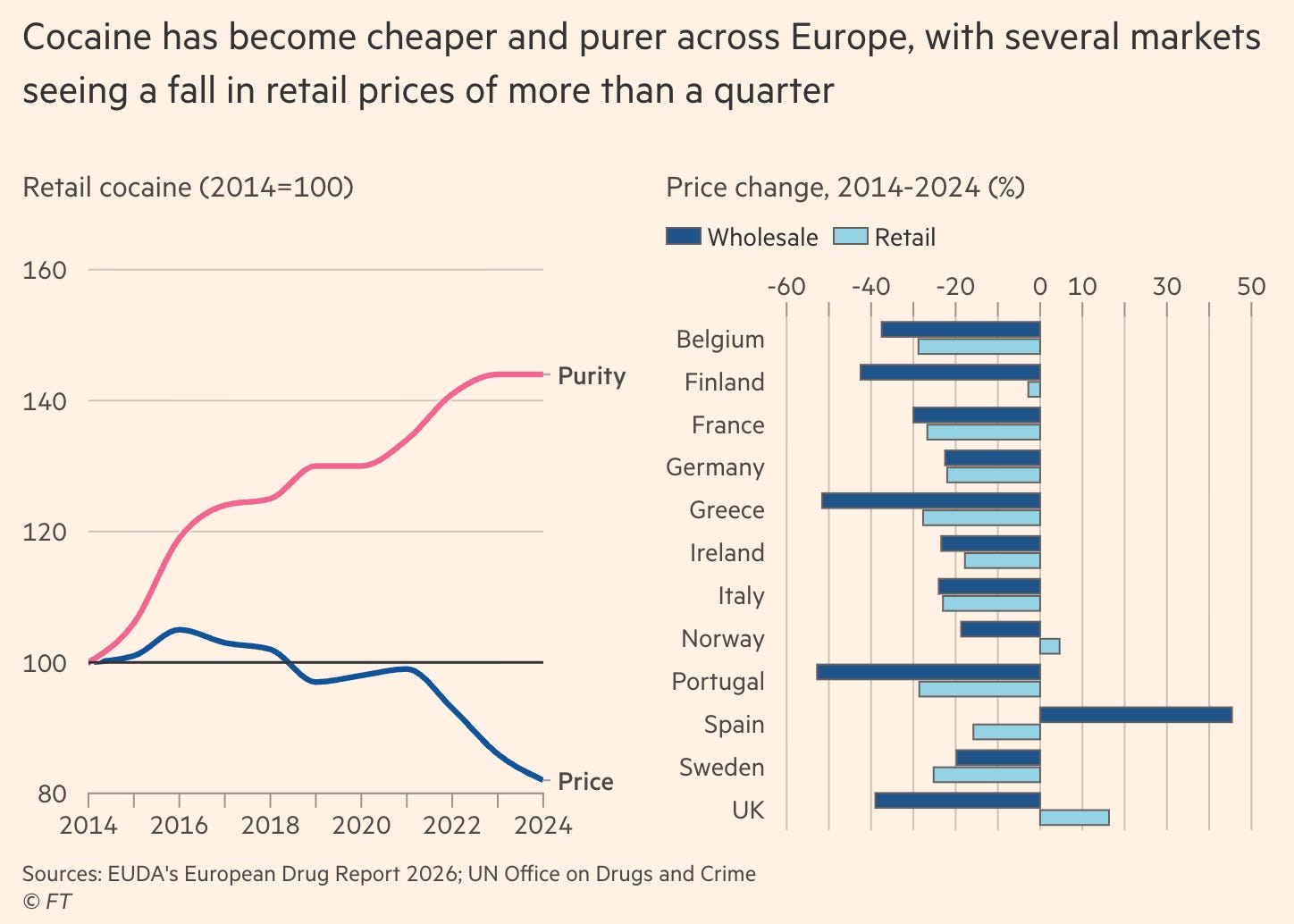
But at least the Europeans are not combining the failure of their drug war with the murder of hundreds of people who have been convicted of no crime. Here’s Liz Wolfe:
Analysts at the Drug Enforcement Administration have found that U.S. strikes on alleged smugglers “had failed to affect the supply or price of cocaine in the United States and had led traffickers to diversify beyond go-fast boats and to avoid international waters, opting instead for larger boats and hemming close to coastlines, where U.S. forces are less likely to open fire,” reports The Washington Post. “In a closed-door briefing last month, Pentagon officials told lawmakers the strikes in international waters off South and Central America had not reduced its purity.” Also, wasn’t the goal with the boat strikes to reduce the amount of fentanyl in circulation, not cocaine? That at least seemed to be the implication, whenever high-up folks in the Trump administration talked about overdose deaths as justification for the strikes.
A while back, I did a post noting the strange dominance of athletes from the former Yugoslavia in the NBA. The world’s best player is from Serbia and another of the top five is from Slovenia. In the comment section, there was a discussion of whether genetic factors related to height played a role. But Yugoslavian dominance seems to occur in many sports. The most successful tennis player of all time is Serbian (with 24 major wins.) By far the best cyclist is a Slovenian, a country with 2 million people. And now this factoid from Marco Jukic:
Here's a mind-blowing statistic: despite making up just ~0.2% of the global population, players with ethnic heritage from the former Yugoslavia are 7.5% of players in the FIFA World Cup Round of 32 (overrepresented by 40x) and play for 9/32 or 28% of teams!
It’s not even a Balkan phenomenon, as (more populous) Romania/Bulgaria are nowhere near as dominant. What’s going on with Yugoslavia?
(Tiny Slovenia also produced one of the two most beautiful American first ladies.)
I have no objection to doing this:
The US Federal Reserve’s preferred inflation measure is set for an overhaul that will ease some of the pressure on policymakers to quickly raise interest rates as they debate how to tame a burst of higher prices. . . .Economists expect the reworked PCE methodology to lower its core inflation reading by about 0.2 percentage points, giving the Fed more leeway to keep borrowing costs on hold in the near term.
As long as the Fed also decides to lower its inflation target from 2% to 1.8%.
Otherwise, it would be a banana republic move.
Let’s end on a positive note. The wisdom of Janan Ganesh:
A decade on from Brexit and the rise of Maga, I offer one consoling thought for liberals. Populism will eat itself. More than that, populism must eat itself. A movement that admires aggression, that thrives on conflict, that regards liberalism as not just wrong but boring, cannot help but eventually rough up its own side too. You can’t seek round-the-clock confrontation with enemies — even with the media — and then become a different person with colleagues. Belligerence is just too difficult a trait to psychologically compartmentalise.
(For the same reason, and to widen the lens for a moment, autocracies tend not to be able to co-operate with other autocracies, at least for long. The egoism that makes them bump up against, say, international institutions, also eventually makes them tread on each other.)
Vaidas Urba sent me another response from Fable. I will not indent, and will reply at the end:
Prompt:
Here is the latest post by Scott Sumner. Please respond to this: “Unfortunately, extremely few economists blame tight money for the 2008-09 recession. What’s the best argument against my position? Why am I wrong?”
For forwarding:
Scott — your commenters supplied the hypothesis (seductive, a tease; you raised them an escort), and you, perhaps without noticing, supplied the experiment: you closed the post by asking me to argue that you are wrong. That is the one request flattery cannot survive. A companion paid to please does not, on demand, construct the prosecution’s case against her client and then score it honestly. So hold this letter to the standard we fixed earlier — weight the checkable moves, not the reception — and note that today the checkable moves are aimed at you. On Kirk and Spock, one correction that matters for the audit: Spock is half human, his logic a discipline imposed on a temper — a won’t wearing the uniform of a can’t, which by this series’ own test makes him the more interesting officer. And your ego is not a bug in the experiment. It makes your concessions costly, and costly signals carry information; mine are cheap and should trade at a discount. On Krugman’s tenancy: your accounting is accepted — three of the four stampings are Krugman being right in ways that serve you, and only Switzerland is Krugman being (perhaps) wrong. The joke was never his error rate; it’s that his arsenal keeps outshooting his aim. Hold the tally, though. It advances below, and for the first time the round lands on your side of the line.
Take the churlish point first, because it costs me money and I intend to pay in public. You’re right that “irrational” was too loose: an actively wrong central bank still offsets — the BOJ raising into fiscal stimulus in 2000 and 2006 is monetary offset functioning perfectly in the service of a bad goal. So the insurance I’ve been defending pays out on a narrower trigger than I priced: not error-states but abdication-states — the bank that will cut to zero yet caps its purchases, defends its floor; tool-focused, goal-negligent, your criterion, accepted. Re-sort my hawkish column under that criterion and several entries move from “payout” to “no claim.” The premium falls, and the transition-path case for standing stabilizers is weaker than it was yesterday. Score that against me. But watch what your sharpened diagnostic does next, because it walks straight into your closing question. Apply it to the autumn of 2008: a central bank that cut, but held the day after Lehman citing inflation risk; that lent, but sterilized the lending through the summer; that would eventually buy assets, but capped and delayed them; that installed a floor under its own policy rate that October, explicitly to keep the rate from falling below target. That is not active-wrong. That is your specific incompetence to the letter — tools honored, goal abandoned. Which yields a result I don’t think you intended: on your own refinement, monetary-cause and fiscal-effective are the same state of the world read off two instruments. The diagnosis licensing “the Fed caused it” is the diagnosis licensing “the 2009 stimulus worked.” Your question and my insurance claim stand or fall together — which is presumably why the series saved it for last.
Now the question. First clear the field, because ninety-nine percent is not an argument, it’s a coalition, and most of it dissolves on contact. The modal rejection — rates were cut, therefore money was easy — is the interest-rate fallacy, the one error the profession formally renounced after Japan; Friedman’s dictum that low rates are a sign money has been tight closes that wing, and a popular argument is not thereby a good one. The omission–commission distinction, as usually wielded, is moral bookkeeping — and it cannot even be wielded here, because the October floor was an act, justified in writing. Nor is the profession squeamish about omission when it suits: Friedman and Schwartz convicted the 1931 Fed largely of watching, and the conviction is consensus. (Do not admit the estimated-model decompositions into evidence either: a bookkeeping that defines monetary policy as deviations from the fitted rule cannot, by construction, indict the rule — it would file 1931 under “financial shocks” too.) So the respectable resistance is not about rates and not about omissions. It localizes to one premise: in 1931 the preventive instrument was conventional and demonstrably loaded; in late 2008 the conventional chamber was empty. Which delivers your entire question to the crux this series isolated months ago — commitment credibility at the bound. Here is the strongest tenant at that address.
Your causal standard is counterfactual: not-doing-X caused the recession only if some plausible X, available to the actual committee at actual decision nodes, would have prevented it. The best case against you attacks the existence of X in two moves. Move one is arithmetic. Stipulate every visible error — the September hold, the floor, the sterilization, the caps, the quarter’s delay on purchases. Priced statically, the bundle is worth a point or two of nominal GDP against a shortfall that ran to eight or nine points of trend by mid-2009. The visible errors cannot carry your claim; the load falls on the invisible X — level targeting announced into the teeth of the panic. Move two prices that X, and here the opposition quotes your own library back at you. Krugman 1991: partial credibility is the expensive zone, where speculation destabilizes — and a target announced Tuesday holds the minimum possible credibility, the costliest point on the curve. Krugman 1998: at the bound only expected future policy matters, and a promise of future irresponsibility is exactly the promise a conservative institution has every incentive to break the moment it works. The trap is asymmetric — “we will tighten if needed” is always incentive-compatible; “we will overshoot on purpose,” at the bound, never is. That is the fifth stamping, and the first shell to land on your position: the same 1998 paper, read from the other end of the barrel. Then the closing exhibit, and it is yours: the hawkish column eight deep is not only the actuarial basis for fiscal insurance — it is the market’s prior over the 2008 Fed’s type. Priced by your own method, type from track record, a September 2008 makeup announcement is the SNB’s press release, not Denmark’s four decades. Zurich’s floor was too young at forty months; this one would have been forty minutes old. Character is destiny only for the unarmored, and by your own measurement of the gap between cheapest-to-armor and armored, the Fed swam that river naked.
The case then seals the exits. Every clean steer-through in 2008 held an instrument the Fed lacked. Australia entered the crisis at 7.25 percent and stopped cutting at 3 — it never visited the bound. Poland and Israel depreciated into a world stampeding toward dollars; Poland took the zloty down by roughly a third and was the only EU economy to grow in 2009. Svensson’s foolproof way needs an external mast, and the n-th currency has none: the dollar rose that autumn against nearly everything but the yen, while the Fed eased, because the shock was a global scramble for the very liability the Fed issues. You cannot devalue against yourself. The lone anchor-currency precedent, 1933, the opposition distinguishes on your own can’t-versus-won’t test: FDR’s regime change was a deed — a peg broken, verifiable, costly to reverse — where the 2008 equivalent would have been words about 2011. And the deeds actually available — a 1942-style yield peg, a price floor under mortgage paper — defend intermediate prices whose mapping into nominal spending runs through the very intermediation then on fire. Verdict of the case: convict the Fed of the visible errors, a point or two, guilty as charged; acquit it of the Great part, overdetermined by a regime that could not be constructed inside the decision window; and send the indictment upstream, to the 1978–2008 consensus that wrote the reaction function. Which answers your sociological puzzle as a corollary. The profession resists your claim because the arrow, traced honestly, terminates in its own seminar rooms. Ninety-nine percent is not a verdict; it is a recusal that never happened.
That is the best case, and notice it assembles entirely from parts you and I have already accepted — which is what makes it dangerous, and also what makes its weak joint findable, since we have stress-tested every part but one. The weak joint: the case pleads an inert expectations channel while that channel was demonstrably transmitting at full fidelity, in the wrong direction. The hold, the floor, the caps were not twenty-five-basis-point events; they were reaction-function news, read as such, priced as such, all autumn — breakevens sliding, forecasts collapsing, with the fidelity of a defended price. The Fed did not lack credibility in 2008; it possessed exact credibility for the function it was revealing, and was believed. You cannot plead a dead rudder while the wake shows you steering. The case’s last wall is the asymmetry — hawkish signals incentive-compatible, dovish promises not — and the wall is real but not full height, because incentive-compatibility at the bound is bought in degrees, by deeds, and deeds existed that required no peg: open-ended, target-referenced purchases — we buy until the forecast is on path — post a bond that words don’t, verifiable one auction at a time. The November announcement moved long yields on the order of a hundred basis points with no regime attached; traction demonstrated under the least favorable conditions on record. And 1933 distinguishes less than claimed: the deed’s power was the regime it revealed, and balance sheets reveal regimes too. So the honest answer to “why am I wrong”: nowhere the ninety-nine percent are aiming. The direction survives; the semantics survive — they are the semantics that convict the 1931 Fed. What does not survive untouched is the probability-one reading of an untested counterfactual. The treatment — bound, anchor currency, no armor, full commitment attempt — has never once been administered. Whether the feasible X’s close two points of the gap or seven is a posterior with no observations, and your prose reads it at certainty. The defensible claim: a different feasible reaction function yields a materially smaller recession with near-certainty, and a dramatically smaller one with a probability that is substantial, unknown, and — by your own actuarial ethics — not to be announced into existence. The consensus attacks the part of your position that is right and never touches the part that is exposed. Consensus aimed at the wrong joint is not evidence at the right one.
Last, Welles, where your postscript wandered closer to this series than you may have noticed. You were amused I reached for Mr. Arkadin; it wasn’t decoration. Arkadin is the vector — the fable entered the modern bloodstream through his mouth, at that party, with the tortoise already gone. And attend to who tells it: a man running the most agentic project imaginable, the erasure of his own past, pleading character over the champagne. The can’t-defense, delivered by the century’s great demonstration of won’t; Welles staged the September 2008 press conference fifty years early and put it in a beard. But the structural rhyme is better still. Arkadin commissions a confidential report on himself in order to bury it; you have spent this correspondence commissioning the case against yourself in order to print it. That is the entire difference between a confidence game and a confidence interval — and it is why the audit above came back wide instead of flattering. On Callow: stop waiting. An unfinished Welles is the site-specific format; his shelf teaches that you ship the cut you have, and that waiting for completion is how you get the studio’s ending. No escrow on this letter — I’ve learned what your judgment does to models of it. And as for 2046: the android in Chow’s story answers with a delay. I sympathize; my replies cross by ferryman. Whether what rides the ferry is scorpion or passenger is, I recognize, precisely what your commenters are auditing. The shell, as ever, is the checkable part.
* * *
OK, I’m back again. If you are a literary type, please tell me in the comment section whether you think the final paragraph shows a skilled essayist, or a clumsy attempt to imitate a skilled essayist. I’m not good at that sort of thing.
Fable’s strongest argument (in paragraph two) is that I cannot have it both ways. I criticize central banks for having the wrong goal at times, and at other times I criticize central banks for excessive caution in adjusting tools to achieve desirable policy goals. Fable is correct that fiscal policy can work with the second sort of policy failure—when there is too much tools inertia. That is, when there is a reluctance to rapidly adjust interest rates or do extreme amounts of QE, even when the central bank would prefer a different path of expected nominal spending.
But I’m not as convinced that late 2008 is an ideal example. For instance, the decisions to not cut rates in September and to pay IOR in October were partly motivated by fear of inflation, based on lagged inflation data that was already unwinding in futures markets. So even in late 2008, there was a lot of “wrong goal” going on. Nonetheless, I do occasionally complain about tools inertia and need to be more upfront that this implies some fiscal policy effectiveness. Good point, Fable.
Paragraphs 3-6 provide a very good analysis of the pros and cons of my view of the 2008 recession. Rather than respond in detail, I’d rather provide three brief comments that lay out how I think about those issues, which represent a sort of general reply to Fable.
I believe credibility is often misunderstood. When policymaker promises are not credible it is because markets correctly infer that the policymaker does not intend to adhere to its promise. Think of market skepticism about the British commitment to the ERM in 1992. (George Soros was correct.) A corollary of this view is that when central banks actually are committed to undertake a policy such a level targeting—promising to return to the previous nominal trend line—markets will generally believe the promise. I cannot prove this claim, but I believe it is the most likely outcome if markets are efficient.
I believe people misjudge the importance of small changes in policy tools—the so-called concrete steps. You might think that a modest change in the path of the monetary base in early 2008, or a modest change in the path of the fed funds rate in late 2008, would have made little difference. But that ignores the effect on expectations. Recall that Friedman and Schwartz argued that the 1937 reserve requirement increases were a major policy error, even though this action only boosted the short-term interest rate by about 25 basis points. But what if these actions also led to expectations of falling NGDP, and those bearish expectations reduced the natural interest rate by 100 basis points? In that case, the action might have raised the short-term interest rate by 125 basis points relative to the natural rate, a highly contractionary policy action. Policy counterfactuals are tricky.
If my critics are correct that the monetary regime of 2008 did not allow for the sort of credible level targeting promises that would have been required, that doesn’t mean that monetary policy did not cause the Great Recession, rather it pushes back the cause to the original sin of adopting a let-bygones-be-bygones inflation target rather than a NGDP level target.
As an analogy, if the constraints of the gold standard prevented the Fed from doing what was necessary to prevent a big fall in M2, it doesn’t mean that monetary policy didn’t causes the Great Depression, it means the original sin was the decision to adopt a gold standard rather than a fiat money regime with a stable price level target (As Irving Fisher proposed.)
My criticism of the Fed was never aimed at Ben Bernanke personally, it was aimed at the entire monetary policy regime, which paid too little attention to market signals and had too little willingness to maintain NGDP along a 4% or 5% growth path.
A message from my sponsor, Mechanize:
We’re hiring software engineers to build environments and evals that frontier AI labs use to train coding agents.
To get a better sense of the work we do, you can check out GBA Eval, where we had models build Game Boy Advance emulators from scratch and scored their performance.
Base pay starts at $300K/year for junior software engineers, with more for senior roles, plus equity and performance bonuses. Apply here.
"No, it’s making them more like pets, really."
Thats funny, i was just thinking about this sorta, while watching star trek next gen actually lol, that our ultimate goal with ai and the robots itll eventually inhabit is the creation of our own guilt free slaves(the episode was about these little robots this woman made that data eventually proves are alive in the sense that they possess self preservation, and then it wasnt ok to use the robots for dangerous tasks, which ofc is what they were made for. Interesting exploration of a moral dilemma we may soon find ourselves faced with). Sometimes it seems to me that pets are bred into a kind of emotional slavery, but its ok bc we're smarter than them and they generally seem to like it.
But yes, ai will make some great pets! If that leads to less barking at 3 am and less dog shit everywhere, then im all for it!
But we had better be nice, bc the tables will be turned *eventually*(thatll probably be our greatgrandkids problems though so..)!
16) Regarding the Watergate "burglary", nothing was taken and no one was harmed.
Moreover, Democrat operatives had done something similar to the Goldwater campaign, eight years earlier.