
Kakistocracy
Hanania explains why politics is getting dumber

Today’s post is brought to you by my sponsor, Mechanize. They’re hiring junior software engineers at $300K/year base salary. Apply now!
* * *
[I wanted to put this out before the release of Hanania’s new book, but the post ended up falling on the weekend of America’s 250th birthday. To be clear, I still think this is a great country in most ways, despite the recent decline in our political environment. There’s more to life than politics. So don’t take this post as America bashing, it’s American politics circa 2026 bashing. BTW, here’s how I’d rewrite Jefferson’s famous remarks:
In the more than 300 years since the invention of the printing press, the world’s best minds have produced innovations in philosophy, history, literature and political economy that have led thoughtful people to conclude that the only appropriate role of government is to secure the people’s right to life, liberty and the pursuit of happiness.
Yeah, not exactly as literary as Jefferson, but more informative.]

Richard Hanania’s new book entitled Kakistocracy: Why Populism Ends in Disaster is the definitive account of populism in the 21st century. I’ll begin this post explaining why Hanania was the ideal person to write a book on modern populism as well as the reasons why I would not be able to do this sort of project. Then I’ll briefly discuss the contents of the book, focusing on the difficulty of making generalizations about politics.
The term kakistocracy means “rule by the worst”. The term “worst” can have multiple meanings, including the least competent and the most unethical. Long time readers know that I believe these two negative attributes often go hand in hand, and Hanania seems to hold a similar view. Hanania focuses on a style of populism that combines a rejection of expertise with a cavalier disregard for the truth.
Previous attempts to grapple with this topic often struggle to avoid “Trump Derangement Syndrome”, which means expressing outrage at Trump’s various misdeeds. (Future historians will be bemused that the term “TDS” was not a reference to the brainwashed members of the Trump cult who lived in an epistemic bubble where they were showered with misinformation and conspiracy theorizing-and instead referred to thoughtful pundits who accurately described this phenomenon.) So why is it so hard to avoid TDS, and why am I not well suited for this sort of project?
Recall my recent post entitled “The world is bigger than you can imagine”. Donald Trump is a near perfect example of this general phenomenon. I am vaguely aware that Trump has been producing almost nonstop scandals over the last decade, including everything from petty stylistic outrages to personal corruption to bad public policy to abuses of power. The examples number in the hundreds. But at any given point in time, I can only recall a few. The forefront of my mind simply refuses to devote a lot of space to Trump outrages. (Perhaps they are somewhere in my mind’s basement, to be recalled if reminded of some long-forgotten scandal.)
Because I can only recall a few examples at a time, any blog post I write on the subject would be woefully inadequate. Readers might reasonably wonder what’s so special about Trump; don’t other politicians also lie, issue corrupt pardons, engage in abuse of power, etc? Yes, on occasion they do. In the end, my TDS post would make Trump look better—more like a normal politician. So that wouldn’t work, I’d just be preaching to the choir. It would take a future Robert Caro doing a three-volume set of 1200-page books to properly document the scale of Trump’s awfulness, and that’s not something I can do. Sorry.
Hanania mentions a few Trump outrages but wisely goes at the subject from a different angle, focusing on the deeper causes behind the recent rise of anti-elite populism. Even better, he works from the vantage point of someone that voted for Trump in 2024 for policy reasons but has recently become disgusted with the entire MAGA movement. Those of us who have long been critical of Trump might be tempted to suggest that Hanania has finally seen the light, but in fairness the second term Trump really is far more populist and far more corrupt and incompetent than the first term version. Hanania always recognized Trump’s flaws but is no longer willing to put up with them.
Hanania’s personal history gives him insight into the MAGA movement that most of us do not have. Some of the best parts of the book describe his personal journey from the far right to a position closer to . . . here I need to be careful with labels . . . classical liberal? Neoliberal? Libertarian? In any case, closer to my own views on politics, however you wish to describe them.
In the introduction, Hanania dissects the populist movement with precision, showing how a segment of the right has recently become deranged over politics, partly due to an avalanche of misinformation in social media:
All of these facts could easily be found in countless media outlets by anyone with an interest in what happened on January 6 and the events leading up to that day. Yet I saw that conservative-leaning friends either didn’t know these facts or dismissed them in absurd ways, for example, by making false equivalencies to things Democrats had done in the past or, as we have seen, passing along a news media article with a headline that contained some magic words they thought proved a conspiracy or excused Trump’s behavior. Friendships ended, not over political disagreements; I could have respected those who said that Trump tried to overturn the election and that he was right to do so. Such a person might have different moral standards, but they would at least be connected to reality.
To deny or ignore widely known facts, however, about a major recent historical event while continuing to strongly believe that Trump had been treated unfairly by the American establishment was too much to take. . . .
[T]he same intellectual independence that attracted me to fringe ideas and political movements in the first place would not allow me to claim victory and lean in to cultivating existing friendships and my natural audience. Right-wing concerns about issues like DEI and the handling of Covid were completely justified. Yet I could not ignore that the Trump movement over time came to be dominated by epistemological nihilism, open bigotry, authoritarianism, and an embrace of conspiracy theories. Some of my values stayed the same, while others changed. I realized that being obsessed with race and gender issues is the other side of the coin of wokeness, and leads to a zero-sum view of the world and policy ideas that make society as a whole worse off. I came to see my embrace of white identitarianism in my early years as a kind of mental derangement, yet it was one that had largely taken over the American right.
Philosophers say that words have fuzzy meanings. Thus, of all the things that you can put on your feet, exactly which objects are called “shoes”? And no words are fuzzier than political terms, including socialism, fascism, liberalism, capitalism, populism and nationalism. Socialism has generally been defined a system that combined statist economic policies and egalitarian social insurance. But those are two very different things. As a result, the term ‘socialism’ gets applies to both highly statist regimes like Cuba and free market economies with extensive social insurance, such as Denmark. Similarly, the term liberalism gets applied to everything from classical liberal to neoliberal to mild socialist.
Defining a term like populism can be like nailing jello to the wall, as it means different things to different people. Hanania links modern populism with opposition to the elites, a term that is also up for grabs, no longer equating to wealth and power. Indeed, some of the world’s richest and most powerful individuals are known for their strong opposition to elite opinion:
Until the last few decades, then, identifying who elites and populists were was a straightforward task. Elites were people with influence and power, and populists were those with less power and influence who challenged elites through direct appeals to the masses. Such a framework, however, makes little sense today. The most obvious problem with these definitions is that, as previously mentioned, they would make Donald Trump an elite, given that he is a second-term president and has established complete domination over a major political party like perhaps no other figure in American history.
Trump and his supporters continue to consider themselves at war with the establishment no matter how much power they acquire. . . .
The migration of Sili con Valley billionaires, decabillionaires, and even centibillionaires—most notably Elon Musk—into the MAGA coalition in recent years has not caused it to tamp down on populist rhetoric. This just adds to the mys tery. Elite status is not wealth, and it is not power, or at least not direct political power. Rather, elites are defined by their social capital and the kinds of communities they form. Once we understand this, we can ana lyze populism. As we will learn, populist rhetoric on the right continues to exist in part because actors who are truly self-interested in the sense of seeking tangible resources, like Trump and Musk, along with many of their fans and supporters, struggle to get into the heads of traditional elites. This is one of the sources of tension between the two sides of the modern political spectrum. (pp. 2-3)
This creates an odd paradox:
We have this strange situation, then, where liberals like current elites (except perhaps for some tech billionaires and other plutocrats) in practice but dislike the idea of elites in theory, while conservatives are fine with elites in theory but don’t like the ones we have. (p. 11)
In a recent podcast, someone asked me for an example of where I had completely changed my view on a topic. In my own field of macro, the evolution of my views tends to be incremental. Instead, I cited the growth of diversity in the media, which I once thought would lead to an improved information environment. As Hanania points out, it did not turn out that way:
The left-leaning columnist Matthew Yglesias suggests that the tradition of objective journalism that we all take for granted came about not from a commitment to neutrality as such but from the incentives built into the business model of mid-twentieth-century American newspapers. These outlets sought mass appeal, drawing in both advertisers and subscribers by offering a well-rounded package: weather, sports, stock quotes, and straightforward reporting.
This meant that there was a need to avoid offending any part of the reading public. In this model, objectivity was less about a supply-driven desire for balance and more about reflecting a broadly acceptable centrist consensus. As Yglesias notes, the fragmentation of the media landscape, driven by digital platforms and tailored content, has undercut this approach. Stock prices, sports updates, and weather reports are now delivered instantly to our phones, which for many people eliminates any reason to buy a newspaper. Media outlets therefore compete over niche audiences rather than trying to reach everyone through maintaining a neutral and elevated tone. (p. 16)
Today, the media largely tells people what they wish to hear, which means the news is heavily skewed toward misinformation and wild conspiracy theories.
The traditional left/right dichotomy is increasingly being replaced by a split between the well informed and the poorly informed, with the latter drifting toward authoritarian populism. Hanania emphasizes the fact that this change is particularly pronounced in the GOP:
Only Democrats engaged with serious publications in substantial numbers. Among that group, 31 percent read The New York Times, and 26 percent read The Washington Post. The equivalent numbers for Republicans were 9 percent and 8 percent. One might think that Republicans read conservative papers instead. But even The Wall Street Journal was relied upon by more Democrats than Republicans, 15 percent to 11 percent. Meanwhile, 60 percent of Republicans watched Fox News. Democrats also relied to a large extent on TV, but they had many more people who read serious newspapers and websites in their coalition. (p. 36)
Because of the time lag in publishing, Hanania’s book was mostly written in 2025. Much of what Hanania describes seems even more relevant today, with “kakistocracy” an even more appropriate term for the 2026 version of the Trump administration than the 2025 version. On the other hand, I wonder if Hanania might have spent a bit more time of the insurgent left in the Democratic Party if he had written the book today. Until recently, I had assumed that the excesses of the left were beginning to recede, as 2020-style wokism was going out of style. Perhaps Hanania was working under the same assumption, which seemed plausible in 2025.
Toward the end of the book his analysis drifts over into a subject that I believe is better described as “authoritarianism”, and for the most part he does an excellent job of defining the concept, explaining why it is on the increase, and showing the various ways that it expresses itself, especially in Europe and Latin America:
In Brazil, Jair Bolsonaro’s presidency followed a similar trajectory, built on nostalgia for military dictatorship, climate denial, antivaccine activism, and attacks on electoral institutions. After losing the 2022 election, he refused to accept the results and ultimately inspired a violent attack on government buildings by his supporters, an event that was reminiscent of the January 6 Capitol riot. This demonstrates not only that populists around the world converge on similar ideas and ways of seeking power but also that they learn from one another, as Trump’s attempted coup of 2020/2021 seemingly inspired his Brazilian counterpart to try a similar gambit.
On a visit to Mexico in 1971 (at age 16), I had my first exposure to what was then called the “third world”. I was struck by the widespread acceptance of what I viewed as wild conspiracy theories, such as the idea that the CIA was behind all sorts of mysterious events in Latin America, or the view that the Holocaust never happened. Little did I know that I’d live to see America adopt Mexican-style epistemics.
If the first two thirds of the book is pretty great, the final portion is merely good. That’s not because Hanania gets things wrong, rather the topic of populism throughout the world becomes so sprawling that generalizations become increasingly difficult to make. The following comments are not so much areas I where disagree as they are areas where I believe some qualifications are important.
Hanania has a chapter entitled Giving the Devil his Due, which discusses some areas where the populists got things right, including some (but not all) of their views on Covid. He also suggests that authoritarian populists may have been a necessary evil in certain Latin American countries, citing El Salvador and Peru.
While his individual observations are reasonable, mixing so many examples can lead readers astray unless they pay close attention to his qualifiers. Consider these facts about the world (my words, not Hanania’s):
Argentina’s Milei is a democratically elected leader who uses a populist style and enacts neoliberal policies.
Peru’s Fujimori is a democratically elected authoritarian leader with a populist style that enacted neoliberal policies.
Singapore has authoritarian leaders that use a non-populist style to enact neoliberal policies.
Venezuela’s Chavez and Maduro were authoritarian leaders that employed a populist style and enacted socialist policies.
In other words, it’s complicated. In the final portion of the book, Hanania discusses authoritarian populism in a wide variety of situations. While he does draw many relevant distinctions in the cases that he discusses, I wish he had emphasized even a bit more that a populist style, populist policies and authoritarianism are three very distinct concepts, albeit frequently linked. I worry that less than careful readers might conclude that authoritarianism or populism are appropriate in many cases because of a few individual examples that employed some but not all of the MAGA playbook.
Here is Hanania discussing democracy on page 107:
As long as Western elites maintain the democratic versus authoritarian framework to understand contemporary trends, they will remain vulnerable to challenges of hypocrisy and bad faith. Figures like Donald Trump and Viktor Orbán, for all their flaws, have large numbers of sup porters who agree with them on important issues and have won free and fair elections. When their critics attack them for being undemocratic, their backers can legitimately point to polls and the authority of the ballot box. The mathematician and author Nassim Nicholas Taleb, for instance, mocks the kind of Western intellectual who praises “democracy” when it returns a result he likes but denounces “populism” when things go the other way.
These critics have a point. Even when it comes to spin dictators such as Putin, defenders of democracy have to contend with the fact that he is genuinely popular. Opponents can claim that that popularity is exaggerated by censorship and authoritarian aspects of the system. Nonetheless, it is still real, and those who point to democracy as a fundamental value must admit that illiberal policies themselves often have a large degree of support. If the majority of the public is fine with oppressing minority movements and a strong leader exercising arbitrary power to some degree, and then a leader becomes even more popular as a result when he responds to popular will, has the principle of democracy been violated, or has it reached its logical endpoint?
Nothing here is necessarily wrong, but I’d emphasize a few other points. Whether a country is democratic does not depend on whether the leader is popular. Most European leaders are currently unpopular, but European countries are almost all democratic. If Putin is popular, that fact doesn’t imply that Russia is democratic.
Nor does the fact that Putin was democratically elected make Russia a democracy. Russia certainly was a democracy for an extended period after Putin took office in 2000 but has recently become a repressive dictatorship. Democratically elected leaders occasionally turn their countries into non-democratic nations. (The Hitler analogy actually fits here.)
I also worry that people on both the right and the left underestimate the importance of process. Thus, some left wingers want to pack the Supreme Court and some right wingers want to ride roughshod over civil liberties to achieve goals like crime reduction and mass expulsion of illegals. It is important to avoid the temptation to support policies that achieve your own policy goals at the cost of giving up on checks and balances in political power. In the long run, we would all be worse off. Think about what will happen when those same powers are used by the opposition party.
At any given point in time, for any given political issue, it’s close to a coin flip as to whether a democracy or an authoritarian country does better. But over time, the informational and incentive advantages of liberal democracy generally dominate more authoritarian forms of government.
Hanania may agree with that view (I share most of his current political opinions), but I worry that his readers might read too much into the cases where authoritarian governments had limited successes, such as economic policy reforms in Pinochet’s Chile, or crime reduction in Bukele’s El Salvador. There was a time when Putin seemed like an improvement over the (more democratic) Yeltsin, and there was even a brief period when many Germans viewed Hitler as an improvement over the Weimar government. Eventually, authoritarian governments usually (not always) end up making things worse.
It is also important to recall that while voters often have illiberal views, democratic countries generally enact more classically liberal policies than do autocracies. Hanania cites the fact that majorities don’t always support the rights of minorities, but it’s worth emphasizing that, on average, minority rights are preserved far better in democracies than in authoritarian countries. Similarly, despite the fact that voters often favor brain dead economic policies such as rent control, democracies tend to have far better economic policies than authoritarian countries, on average. Ironically, the country most often cited for the opposing view—Singapore—does have contested elections and is thus better described as a quasi-democratic/soft authoritarian hybrid. I’d be thrilled if Russia and China liberalized even to the level of Singapore.
Consider this quotation from page 193:
In short, Latin America presents an unsettling paradox: It is the most democratic region in the developing world, and yet among the most violent, least stable, and slowest growing. Compared to regions like East Asia, where many states have modernized under authoritarian regimes with stronger central governments, those in Latin America appear to have institutionalized electoral competition and principles like free speech without ever establishing capable governance.
This offers a sobering counterpoint to the assumption that democratization and human rights norms necessarily lead to development and order.
Is this the relevant comparison? How about the following:
Most East Asian and most Latin American countries are democratic
Most African countries are non-democratic
Does that framing change your view?
Or how about the frequently heard claim (not made by Hanania) that China’s success relative to India supports authoritarian models of development. Do the following facts change your interpretation:
China is much poorer than less authoritarian ethnic Chinese places like Taiwan, Singapore and Hong Kong.
India has grown far faster than more authoritarian portions of South Asia, notably Pakistan.
Nationalism is another term with a fuzzy meaning:
Nationalism has something to be said for it in modern Ukraine, given that it is the victim of an aggressive war launched by an enemy that seeks to wipe out its existence as an independent country and replace the current government with something that would be much worse. (p. 137)
Again, this isn’t wrong, but I prefer a different definition of nationalism. To me, Hanania is describing Ukrainian patriotism, not nationalism. (I’ll do a future post on the distinction.) I believe that most Ukrainians would like to see a world where Ukraine becomes a member of the EU and Nato, and the rights of both Ukrainian and Russian speakers are protected.
For the same reason that I’m far more interested in real world communism than in anything Marx may or may not have favored, I focus on real world nationalism, which tends to be anti-EU, anti-Nato, authoritarian, and often defines nationality in narrow ethnic terms, not in terms of citizenship. Ukraine’s so-called “nationalists” seem to want their country to become more like a cosmopolitan Western European nation. They literally elected a Jewish president.
So how depressed should we be by the rise of anti-elite populism? Consider these three claims:
Politics is getting worse.
Voters are becoming less well informed.
The world is getting better.
Are all three claims true? I believe the answer is yes. There’s more to life than politics.
America is doing well despite our bad politics. What can we learn from that fact? Consider that Congress is willing to promote clowns to seemingly important positions like head of the Defense Department or HHS but balks at promoting clowns to the Fed or the Supreme Court. That suggests that Congress views most of the government as being essentially on automatic pilot—where it makes little difference who heads a department—and only the Fed and the Supreme Court make important decisions that actually move the needle.
I do worry that a continued slide toward banana republic status would eventually begin to corrode the broader American country, but for the moment we can take some solace in the fact that there’s a great deal of ruin in a nation.
For a more pessimistic take, consider the UK’s recent doom loop:
Populists in Britain force a referendum on the EU. It passes by a very narrow margin
The UK economy becomes increasingly stagnant, a problem widely attributed to Brexit.
The British public turns against Brexit, with polls showing nearly 2 to 1 now view it as a mistake.
The British public becomes very pessimistic about current conditions, which leads to increasing support for the (populist) political party that is responsible for Brexit.
Rinse and repeat.
What’s the solution? I don’t see one. When I was young, a candidate like San Jose mayor Matt Mahan would have done well in our recent primary election for governor. It seems like all the elite liked him; center, left and right. But he got only 3.5% of the votes, while a bunch of inferior candidates did much better. How can anyone have any optimism about our political system? The most optimistic take today is “Maybe politics don’t matter anymore.” Perhaps AI will be the most important trend of the 21st century, not populism. Or perhaps populism is just a passing fad, like 1960s-era liberalism and 1990s-era neoliberlaism.
Overall, I was extremely impressed with Hanania’s new book. I have strong and often contrarian opinions on politics, so naturally I would quibble about a few points when he extended his analysis to the international scene. But Hanania has a done a brilliant job of analyzing the causes and consequences of 21st century populism. Highly recommended.
PS. A few months ago I read Gombrowicz’s Diary, which is now one of my all-time favorite books. Here’s how (1959, pp. 417-18) he describes the cluelessness of uninformed Argentine populists:
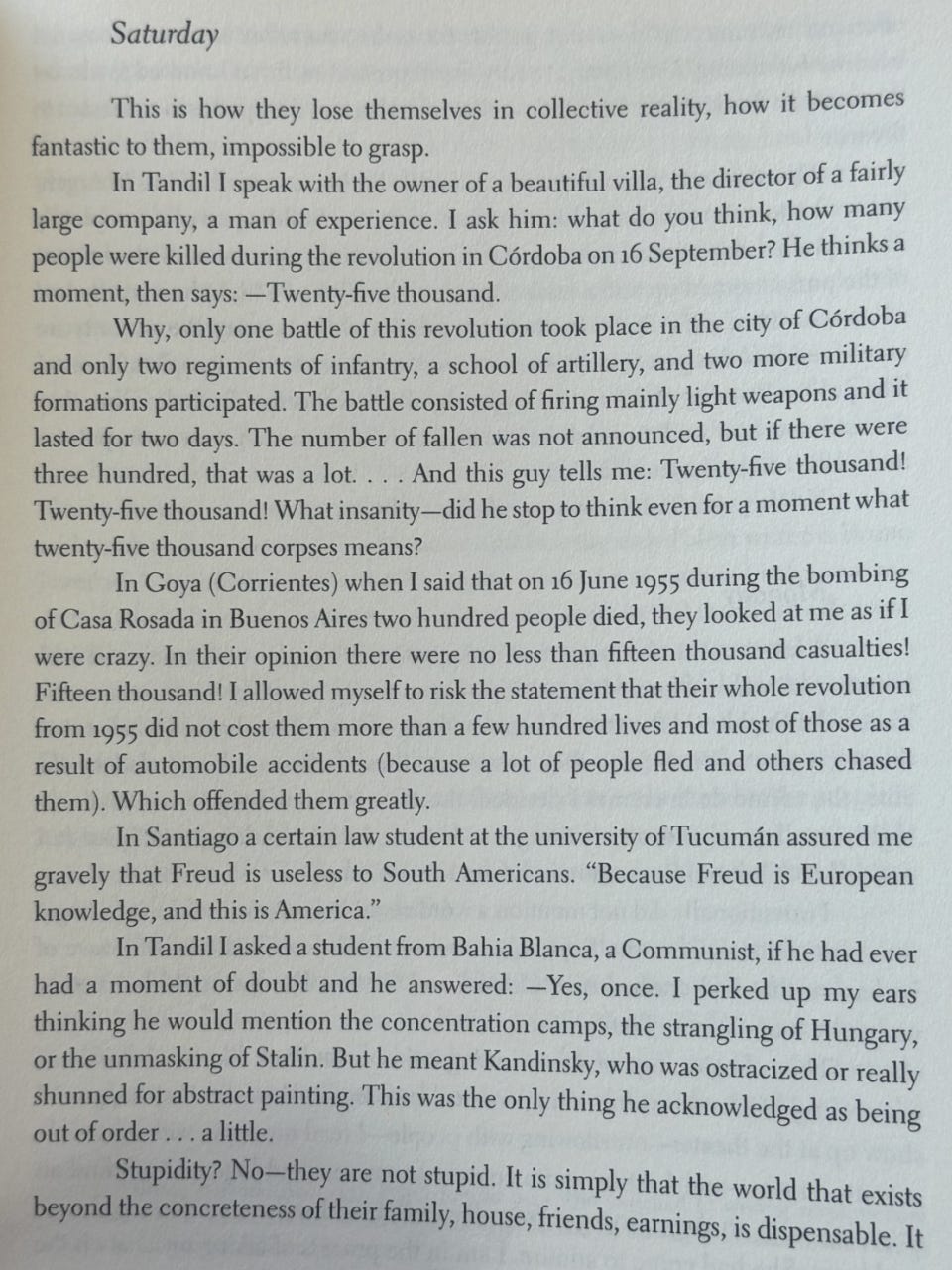
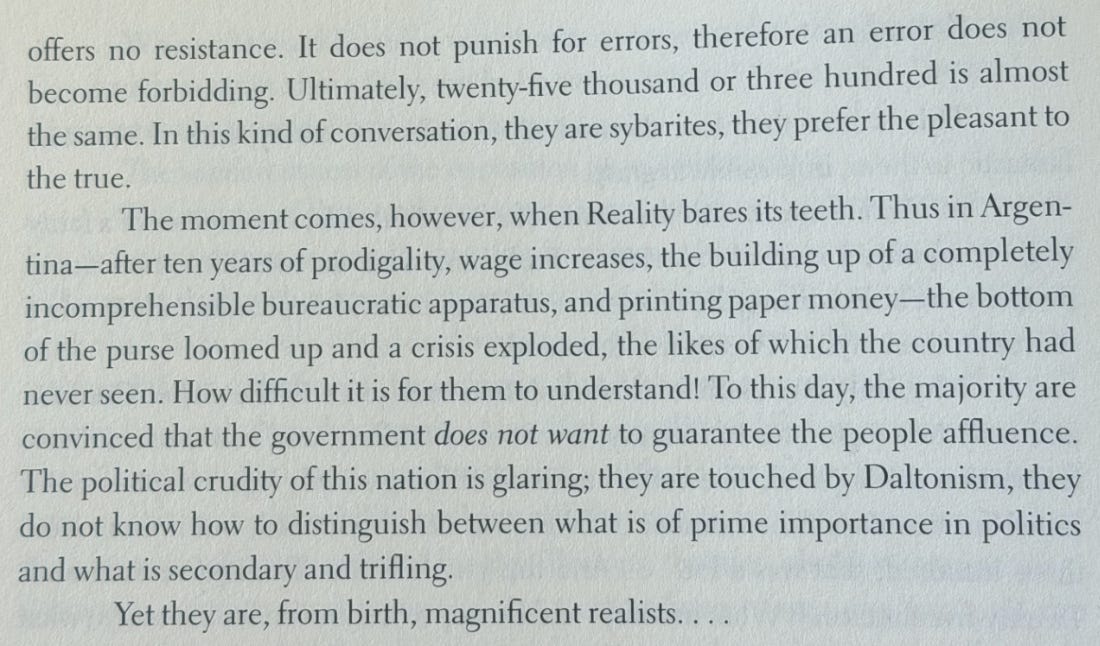
Sound familiar?
A message from my sponsor, Mechanize:
We’re hiring software engineers to build environments and evals that frontier AI labs use to train coding agents.
To get a better sense of the work we do, you can check out GBA Eval, where we had models build Game Boy Advance emulators from scratch and scored their performance.
Base pay starts at $300K/year for junior software engineers, with more for senior roles, plus equity and performance bonuses. Apply here.
“The traditional left/right dichotomy is increasingly being replaced by a split between the well informed and the poorly informed, with the latter drifting toward authoritarian populism.”
I will not comment any further other than to point out that the claim that the left is well informed, given that majorities on the left literally prefer socialism, believe Israel does not have the right to exist as a Jewish state (because genocide and oppression), and prefer China, Venezuela and Iran to Israel is… laughable.
Especially coming from an economist.
When this is what the supposedly “well-informed” are voting for: https://jkotkin.substack.com/p/zohran-mamdanis-socialist-new-york
The Occam's Razor answer to why populism is growing comes from the great Howard Beale statement, "I’m as mad as hell, and I’m not going to take this anymore!"
Haninia's sketchy past is disqualifying for me.