
Learning from Smoot-Hawley
And a dozen other thoughts on the Trump shock


Some people are surprised that the effect of the tariff shock appears to be somewhat deflationary. That’s not to suggest that tariffs will cause the overall CPI to decline (import prices really will increase), rather they are surprised that the GDP deflator seem likely to be negatively impacted. (Recall that the GDP deflator does not include import prices.) Falling commodity prices (especially oil) are one obvious indicator, but recessionary shocks tend to reduce many domestic wages and prices.
Those who read my book entitled The Midas Paradox aren’t surprised by any of this. Here’s a slightly abridged section on Smoot-Hawley:
The June 1930 Stock Market Crash
We have already seen that the 1929 tariff debate may have had an adverse impact on stock prices. In 1930 the tariff debate reemerged with even greater intensity, and this time the impact on stock and commodity markets was unmistakable. By mid-1930 fears of political paralysis in Washington were replaced with worries about the international repercussions of the enactment of a higher tariff. And now there was evidence that investors were concerned about not just the potential impact of Smoot-Hawley on trade, but also on the prospects for monetary cooperation.
The stock market rose throughout early 1930 and on April 17 peaked at a level 48.0 percent above its post-crash low. Then, between April 17 and June 4 the market fell 7.4 percent. After June 4 the decline in the market accelerated sharply with the Dow falling 19.7 percent between June 4 and June 18. And as shown in Figure 2.2, commodity prices, which had been stable in the spring of 1930, also broke sharply after June 4.
Many in the financial community attributed these declines to the enactment of the Smoot-Hawley tariff in mid-June. But why would stock prices have been adversely affected by a tariff that was designed to aid big business? And why would commodity prices decline if tariffs have the effect of reducing aggregate supply? One possibility is that the tariff was viewed as a factor reducing the likelihood of international cooperation on monetary issues. The Commercial and Financial Chronicle warned that the tariff might overturn peace policies, and predicted, “there may be a general tariff war as a prelude to a military war.” News stories discussing the possibility of a European war increased dramatically during 1930, reflecting an environment where monetary policy coordination would be much more difficult.
As with the October 1929 crash, the June 1930 stock market decline was associated with a major tariff fight in the U.S. Congress. To a far greater extent than during the 1929 crash, however, the press (rightly in my view) attributed the June 1930 stock market decline to the tariff bill. And compared with the October crash, during June 1930 the press focused less on the tariff’s domestic political impact, and more on its international repercussions.
As the seriousness of the Depression became more apparent during 1930, opposition to the tariff spread among the public, the press, and even many business groups. The May 10 Commercial and Financial Chronicle (p. 3247) reported that 1028 economists had signed a “document without parallel in American history” urging that Hoover not sign the tariff bill. The document concluded with a warning that a “tariff war does not furnish good soil for the growth of world peace.” In the weeks preceding the passage of Smoot-Hawley opposition poured in from numerous trade associations, including bankers, retailers, and textile producers, as well as from major exporters such as Ford and General Motors.
Hoover had shown great skill in leading the American aid efforts in Europe after the First World War and Europeans viewed Hoover as the “one big man in American public life who is sufficiently acquainted with the European mentality to anticipate the dangers which the new tariff holds for American trade abroad.” Thus European opinion initially may have underestimated the likelihood of the tariff becoming law. As passage became more likely during early June, the press noted a sharp escalation in threats of trade reprisals from overseas. . . .
Although it was considered likely that the President would in fact sign the bill, there was definitely some doubt regarding Hoover’s intentions. His reputation as an internationalist, the opposition of Treasury Secretary Mellon, and his own statements that he would take a fresh look at the issue all served to create some uncertainty. In a controversial decision, he had pointedly refused to get involved in the drafting of what was clearly the most important legislation of the 71st Congress.
On Sunday, June 15, Hoover announced his intention to sign the tariff bill. The next day commodity prices plunged and the Dow fell by 5.8 percent, the largest single-day decline of 1930. The New York Times described the mood on Wall Street:
“There was a feeling of discouragement that extended to all of the speculative markets. Everywhere the disposition was to lay the blame at the doors of Congress. Loud lamentations against the tariff bill were heard throughout the financial district. Traders, gathered in the customers’ rooms of brokerage houses, berated the administration and Congress. One disgruntled person posted a placard in a brokerage house reading, “A Business Administration—the Only Party Fit to Rule?” (6/17/30, p. 1)”
Although one should be cautious in accepting the views of traders, these stories suggest that at the very least there had been some uncertainty regarding Hoover’s intentions. Furthermore, the view that the tariff had adversely impacted Wall Street was not restricted to the New York Times.
The June 21 issue of the Economist (p. 1378) called the signing a “tragi-comic finale to one of the most amazing chapters in world tariff history” and suggested that “fear of its economic consequences at home and abroad was mainly responsible for the heaviest slump of the year in Wall Street.” Passage of the tariff was also associated with declines in foreign markets, including the German bonds that had recently been issued to finance the war reparations. Over the next several years, these bonds would play an increasing role in the U.S. stock market. A June 18 New York Times headline reported that “Peril to War Debts Seen in Our Tariff.”
To summarize, we know that political battles over the tariff were the major news story during both the October 1929 and the June 1930 stock market declines. During the 1929 crash the probability of passage decreased and the political discord in the Republican Party increased throughout late October and early November. During the June 1930 decline, these two factors were almost exactly reversed. The probability of passage increased steadily and the bill ceased to be a source of domestic political turmoil after receiving Hoover’s signature. Between 1929 and 1930 Smoot-Hawley metamorphosed from a domestic political problem to an international macroeconomic problem.
Smoot-Hawley demonstrates the difficulty of quantifying the impact of a political event on the stock market. Even were it possible to estimate the changing subjective probability of passage over time, these probabilities will not fully capture the way in which perceptions of the meaning of the event change over time. For instance, Kindleberger (1973) argued that adverse market reactions to the signing of the tariff bill in June 1930 reflected perceptions that Hoover had not shown leadership. It could be argued that a similar lack of leadership was demonstrated in 1929 by Hoover’s failure to mobilize Republican insurgents in support of the bill.
To give you a sense of how much America has changed over the past 100 years, Hoover indicated that he did not believe it was appropriate to offer even an opinion on various sections of Smoot-Hawley when the bill was being vigorously debated in Congress, as the Constitution delegated that responsibility to the legislature. (What would Hoover think of Trump?)
Recall this sarcastic remark on Wall Street:
“A Business Administration—the Only Party Fit to Rule?”
In 1929, Hoover and the Republicans were assumed to be the pro-business party, the one that was good for business. And the GOP had been good for business during the 1920s. But past performance does not guarantee future success, does it?
So how should we think about the fact that Smoot-Hawley clearly had a deflationary impact? In those days we were on the gold standard, and falling interest rates are deflationary under a gold standard, as they increase the real demand for gold by reducing the opportunity cost of owning gold.
Today, we are no longer on the gold standard, but it remains plausible that a trade war could have a deflationary impact on the price of domestically produced goods. A trade war makes the economy less efficient, and also increases economic uncertainty. This reduces investment and lowers the natural rate of interest. The Fed may cut rates, but central banks generally fall a bit behind the curve in this sort of situation.
The Fed may also be a bit reluctant to cut rates for other reasons. Central bankers are only human, and may be reluctant to “bail out” Trump for what they see as a policy mistake. Perhaps they believe that by refusing to cut rates they put more pressure on Trump to reverse course.
You might say, “It’s not the Fed’s job to interfere in tariff policy.” That’s true, but it’s also not the President’s job to set tariff policy. That’s Congress’s job. Back in 2011, some bloggers proposed a trillion dollar coin as a gimmick to get around the debt ceiling. Trump’s recent tariff decision is a modern equivalent of the trillion dollar coin idea—perhaps it is permissible due to a technicality, but it’s clearly in violation of the spirit of the tariff law. While the Obama administration still cared a bit about appearances (and rejected the coin gimmick), the Trump administration cares only about one thing—what it can get away with.
Here are 12 other short notes, all loosely related to the recent tariff decision:
Some will say, “Voters don’t care about Wall Street, they care about Main Street.” Unfortunately for Trump, lots of voters own stocks, and lots of voters that don’t own stocks buy cheap imported goods from China. Most people will not benefit from his policy, even if it does bring back a tiny handful of manufacturing jobs.
How should the rest of the world respond? My suggestion would be to try to move on from the US and develop free trade groups involving Europe, Asia and other regions of the world. Success is the best revenge. They may also choose to retaliate with tariffs on US goods, but the best response is to make their own economies more efficient. Leave America and Russia to suffer from self-inflicted wounds.
The decline in stock prices should not be brushed away just because we’ve seen stocks bounce back in the past. After Hoover signed Smoot-Hawley, stocks did not regain June 1930 levels until 1955, even though by June 1930 stocks were already dramatically lower than in 1929. Remember, stocks follow something close to a random walk. Trump might quickly fix the problem—or he might not.
It would be unfair to blame proponents of industrial policy for this fiasco, and I won’t do so. But it does point to a more general problem, that industrial policy will not always be implemented by philosopher kings. It won’t usually be this bad, but it will usually be worse than if a Noah Smith-type were in charge.
Business cycles are still unforecastable. This shock does raise the risk of recession (perhaps to 50% or so), but it does not entirely eliminate the problem of monetary offset. The Fed’s response is still important.
Most people have fairly primitive and quite frankly flawed views on causality. Thus suppose this action leads to retaliation by foreign countries, and suppose it causes monetary policy to fall behind the curve. Are those separate shocks, or a part of this shock? It depends on the purpose of your question:
a.) If the question is “Where to assign blame?” then yes, it’s all part of the Trump shock. Those things would not have happened if Trump didn’t start the boulder rolling down the hill.
b.) If the question is more analytical, “What should we do with monetary policy?” or “How much of the business cycle is real shocks and how much is monetary?” then it really does make sense to separate any future recession into two parts, the real shock part (the RGDP decline if NGDP growth stayed at 4%) and the monetary part—the part of the recession due to slower NGDP growth.
Part of the stock decline is a repricing of Trumpism. The same thing happened in October and November of 1929, when a (admittedly modest) part of the stock market crash was due to the market’s growing realization that Hoover was a pretty incompetent president. In early 2025, investors thought they had a “Trump put” because Trump viewed the stock market as an indicator of his success. Now they aren’t so sure.
I also believe this increases the risk of a major war, although that’s further down the road and remains a small enough risk that it probably didn’t play a big role in the recent stock declines. Countries have less to lose from military adventurism. (In the 1930s, international discord did play a significant role in market declines.)
Adam Smith said there’s a great deal of ruin in a nation. It’s at least possible that we will not have a recession. But as Tyler Cowen points out, the cost of slower growth is underrated. A permanent move away from globalization might well be worse from a long run growth perspective than from a business cycle perspective.
This is one case where public confusion—especially reasoning from a price change—may work in favor of neoliberals like me. If the Fed keeps interest rates stable for an extended period, that would be (wrongly) seen as a stable monetary policy. Thus if the economy does poorly then the Trump administration will have trouble blaming the Fed, even if in some sense the Fed is to blame. Again, Trump started the boulder rolling down the hill, so I see him as being to blame for all the ripple effects, including foreign retaliation and monetary policy mistakes. In other words, the public will be right, but for the wrong reason.
Josh Shapiro > > John Fetterman If we continue down this road, by 2028 the public may be in the mood to hand the reins back to the cognitive elite. Could we elect our first Jewish president?
Over at Econlog, I’ve done many posts arguing that fundamental values and process issues are underrated and political positions are overrated. Things like honesty, integrity, compassion, rule of law, wisdom of crowds, democracy, checks and balances, etc. are underrated in importance. Some people that I respect voted for Trump because of this or that issue, despite being aware of his flaws. But in at least some cases, the character flaws are simply too big too overlook. I hope this is a wake-up call.
I’m ready:


PS. Matt Yglesias directed me to this gem:
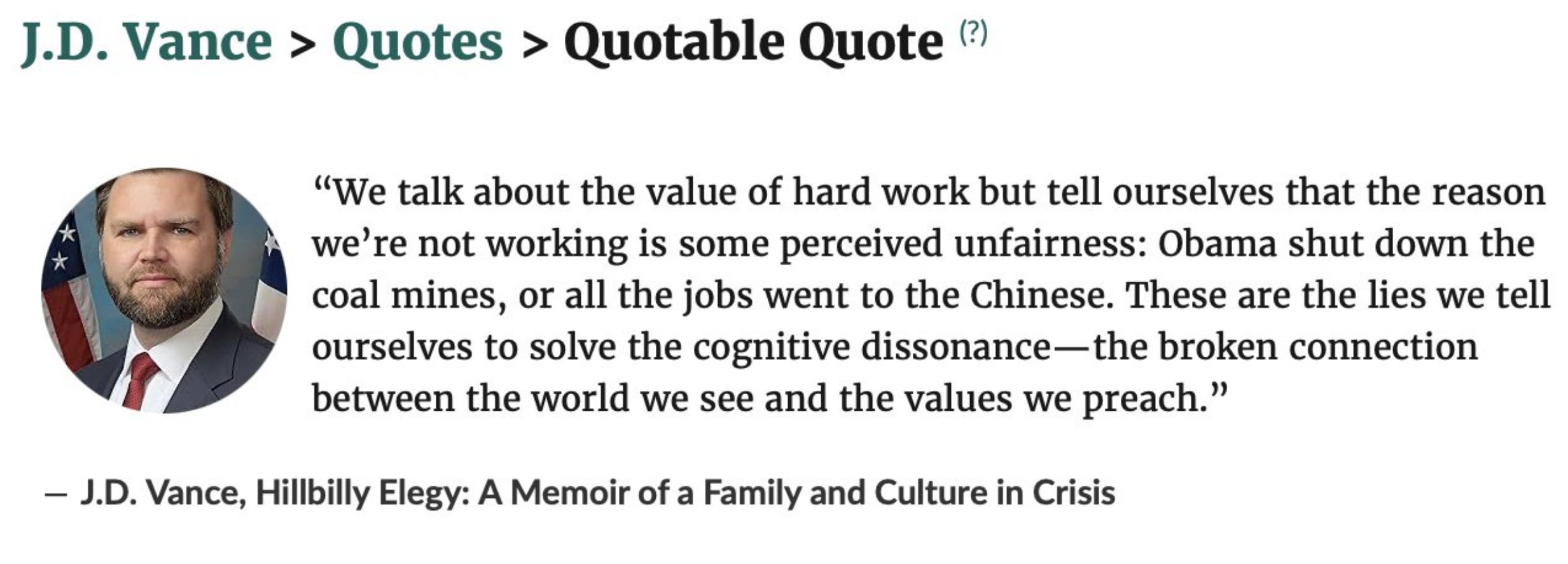
Perhaps they’ve become the lies that Vance tells to his supporters?
Everyone, If the following AEI story is correct (which seems likely), the recent $5.4 trillion stock market crash was ENTIRELY caused by a math error by a bozo in the Trump administration. As I said: "America without adult supervision".
https://www.aei.org/economics/president-trumps-tariff-formula-makes-no-economic-sense-its-also-based-on-an-error/
Do we really understand why Hoover signed the S-H bill (and the Fed was not going to be able to offset the revenue effects). He had the results of expert opinion that was against it and from what I've read of his character, he would not have been swayed by a desire to favor business per se.