

Pollsters typically ascertain public opinion by asking voters how they feel about a given political issue. Here’s an example discussed in the New York Times, back in late 2024:
Americans also tended to support one of Mr. Trump’s signature economic plans: imposing stiff tariffs on goods produced overseas. In September, a New York Times/Siena College poll of likely voters in three Midwest states found that just over half supported expanding tariffs on products made outside the country. After the election, a CBS News/YouGov poll in late November also found that 52 of Americans said they supported new tariffs. An overwhelming majority of Trump voters, 83 percent, said they did.
But once the tariffs began to cause problems, their popularity seemed to decline:
Every public opinion survey conducted in recent weeks supports this conclusion. For example, a CNN/SSRS poll released on March 12 found that 61% of Americans, and 72% of young adults, disapprove of the way Trump is handling tariffs. Fifty-nine percent of Americans without college degrees and 62% of those making less than $50,000 also registered their disapproval. Among white non-college voters, the heart of Trump’s coalition, the president managed only a 50-50 split. Of the Americans who voted for him in 2024, 20% disagree with his tariff policies. A Washington Post/IPSOS poll conducted in mid-February and a Quinnipiac poll released on March 13 produced nearly identical results.
In fairness, these are not identical questions. It’s reasonable to assume that Americans support some tariffs and not others. But you’d have to be willfully blind to deny that recent turmoil in the stock market hurt Trump’s polls numbers. And the market turmoil was largely driven by tariff policies. Not surprisingly, bad economic news is unpopular:
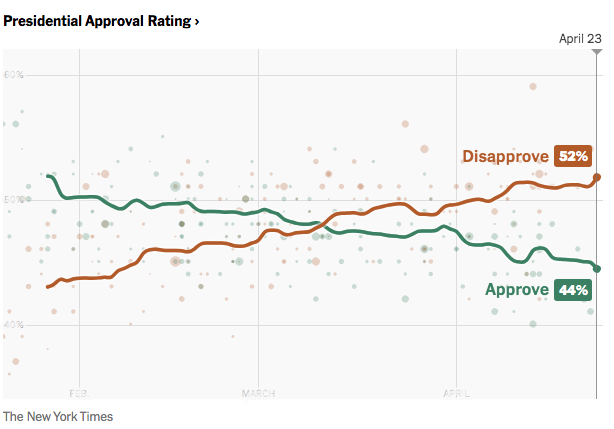
In contrast, good news is popular.
Last year, populists told us that NYC’s congestion pricing scheme was a technocratic experiment being foisted on the public, against their will. And it is true that the policy was unpopular—before it was implemented:
Congestion pricing is climbing out of the Valley of Death.
A new poll released Monday from Siena College found that more New York City residents approve of congestion pricing than don't, a dramatic turnaround from a previous poll by the same firm.
Now, 42 percent of city residents told the pollsters that they think congestion pricing should stick around, despite the Trump administration's attempt to end it, while only 35 percent of city voters think Trump should end it.
When Siena last asked about the toll in December, support for congestion pricing among city voters was underwater: Only 32 percent favored the poll and 56 percent opposed it.
If you poll people item by item on what might be called the “neoliberal agenda”, you’ll often find the public is opposed to policies such as free trade and congestion pricing. But if you were to poll residents of Asia as to which country had the most effective economic policies, they’d probably name a place like Singapore. And Singapore is well run precisely because it adopts “unpopular” technocratic policies like zero tariffs, forced saving, and congestion pricing.
The price controls adopted by Richard Nixon and Jimmy Carter were initially popular. The resulting long gas lines were far less popular, as Carter discovered in the 1980 election. Easy money policies are often popular in the short run—high inflation much less so. Bill Clinton’s economic policies were certainly not populist, but the good economic outcome that he achieved was popular.
The overwhelming majority of voters are “low information voters”. That’s even true of the majority of people that read the New York Times. Democracy doesn’t work because voters are highly skilled; it works (if at all) because politicians know that success is more popular than failure, and thus they have an incentive to produce success.
Even though the stock market is not a perfect indicator of “the economy”, it’s close enough to be useful. Stocks are forward looking, and provide an early signal of problems likely to occur down the road. Thus it’s a good thing that Americans are increasingly invested in the market, as it makes them unhappy with policies that may not immediately hurt the economy, but will gradually degrade it over time. And the phrase “policies that may not immediately hurt the economy, but will gradually degrade it over time” is a pretty good description of many populist proposals.
That's really the crux of the problem with macroeconomic policies-- people like good outcomes. But good outcomes often require policies that are technocratic and hard to explain. Taxing carbon isn't popular; stopping extreme weather is. Conversely, rent controls may be popular; being unable to find an affordable apartment to move into decidedly is not.
But there's a further category of things that both sound unpopular and are unpopular as implemented, but are nevertheless good policy. Take rideshare surge pricing-- passengers hate it and call it price gouging. Reality is... the alternative is not being able to get a car, period. When I lived in New York City in my twenties, it could take well over half an hour to hail a cab in certain neighborhoods well into the night. Sometimes even well over an hour.
Point being, good economic policy is politically super difficult. Trump's crude faux populism is predictably bad, but you would get quite bad results if you introduced crude populism of the Bernie Sanders variety, too. It wouldn't be driven by cruelty the way Trump's policies are, but you don't get special credit for good intentions.
IMO people have a tendency to over-interpret polls. Just because I have an first-brush opinion when I'm asked on the phone doesn't mean it's an issue I care about, or spent a lot of time thinking about. Politicians should be more willing to go against the polls.