
Some like it hot
Our tropical future

The land to the north of the Amur River was originally Chinese territory, before being seized by the Russian Empire in the 19th century. Foreign policy types occasionally speculate that an overpopulated China may find itself tempted to retake this large region. As you might guess from my Greenland post, I find that sort of reasoning to be rather simplistic. That’s not how the modern world works, as Trump discovered when he suggested that the US take Greenland.
I suppose these pundits picture 1.4 billion Chinese people pressed up against their northern border with Russia, needing more space, more “lebensraum”. In fact, nothing could be further from the truth.
China’s northeast (called Dongbei, but known in the West as Manchuria), is losing population at a rate faster than almost anywhere on Earth. Already one of the less densely parts of eastern China, the Dongbei becomes less populated each year. It has a birth rate that is below even South Korean levels, and unlike South Korea it also has a high rate of outmigration, especially to tropical locations such as China’s Pearl River Delta (near Hong Kong.) It is China’s rustbelt.
The northernmost of Dongbei’s three provinces (Heilongjiang) has perhaps the world’s lowest birthrate, less than half of the already quite low birthrate for China as a whole. It has lost 12.5% of its population in just the past eight years. This cold and poor region has little appeal to the Chinese people, and the last thing China would be interested in doing is fighting a war with nuclear armed Russia to make that rapidly depopulating region even larger and colder.
Many Americans are familiar with the fact that our population is moving from the relatively cold north to fast growing hotter states such as Florida and Texas. Less well known is that the same process is occurring in many other areas. Here’s the Financial Times:
China’s aluminium industry has embarked on a green long march, moving millions of tonnes of production from the northern coal country, its stronghold for seven decades, to pockets of the south and west rich in renewable energy.
When people speak of “global warming”, they generally refer to a meteorological phenomenon, the trend toward gradually rising global temperatures. If 40 years ago you had asked a bunch of geopolitical experts how the public would respond to global warming, they might have predicted a gradual migration to the north, as people fled excessively hot temperatures. Instead, the global trend is in the opposite direction, with the southern portions of places like Germany, France and the UK growing faster than their northern regions. This is not true of India, but then fast-growing northern India has hotter and more unpleasant summers than the south.
At a global level, virtually all population growth is occurring at or near the tropics—mostly Africa and South Asia. Even tropical parts of China are still growing, as the country’s overall population declines. The world is getter hotter in a physical sense—the climate is warming—but it is also getting hotter in a demographic sense, as more and more of the world’s population is living in hot places. Even if the climate were not heating up, the average human would be living in an increasingly hot environment due to both migration and international fertility differences.
Instead of Greenland, maybe we should think about buying (rapidly depopulating) Cuba.
Seriously, the lesson here is that experts often misjudge the effect of major long run changes on society. Just as global warming has affected us in ways that were largely unexpected, it seems plausible that other trends such as falling fertility and artificial intelligence might have unforeseen effects. Indeed, we are already seeing a few signs that AI might be a greater threat to white collar jobs than to the manual trades. Not long ago, there was a widespread view that blue collar workers were losing out due to technological change and that plumbers needed to “learn to code”. What would Michael Scott say?
More generally, I believe people tend to underestimate how often they make confident predictions that turn out to be false or wring their hands over societal trends that are already rapidly reversing. Here are a few examples, off the top of my head:
I recall a mini-panic in the 1990s about language. People feared that immigrants were no longer learning English, and that we’d become a country of two languages, like Canada. Instead, it turned out that the children of immigrants almost always do learn English. If anything, the rest of the world should be worried about English becoming the de facto global language. When the language fears didn’t pan out, pundits created other fake crises such as a fear that immigration would boost our crime rates. (It didn’t.)
In the 1990s, I recall a mini-panic about teenage mothers. Since 1991, the rate of births to teenage mothers has plummeted by nearly 80%.
After 2001, there was a widespread view that we were in for a lot more Islamic terrorism on American soil. Instead, terrorism in the US dropped to very low levels. There was a view that flying was becoming more dangerous. Instead, it became far safer.
In the 1990s, there was a view that violent movies and rap music were corrupting our youth, and that this would lead them to commit more crime. Instead, the rate of violent crime has plummeted to much lower levels.
When I was young (in the 1960s), there was fear that the Mafia was exerting ever more control over our society. Since then, the influence of the Mafia has declined sharply.
When I was young, it was assumed that the future would see much more manned space travel, and a big increase in supersonic commercial air service. It never happened.
It might seem “logical” that global warming would lead to people migrating toward cooler regions, but don’t be surprised if the exact opposite were to occur. (To be clear, I still think global warming is a problem, and I do expect some negative effects such as sea level rise.)
PS. This map in Wikipedia shows the former Chinese lands that are now a part of Russia:
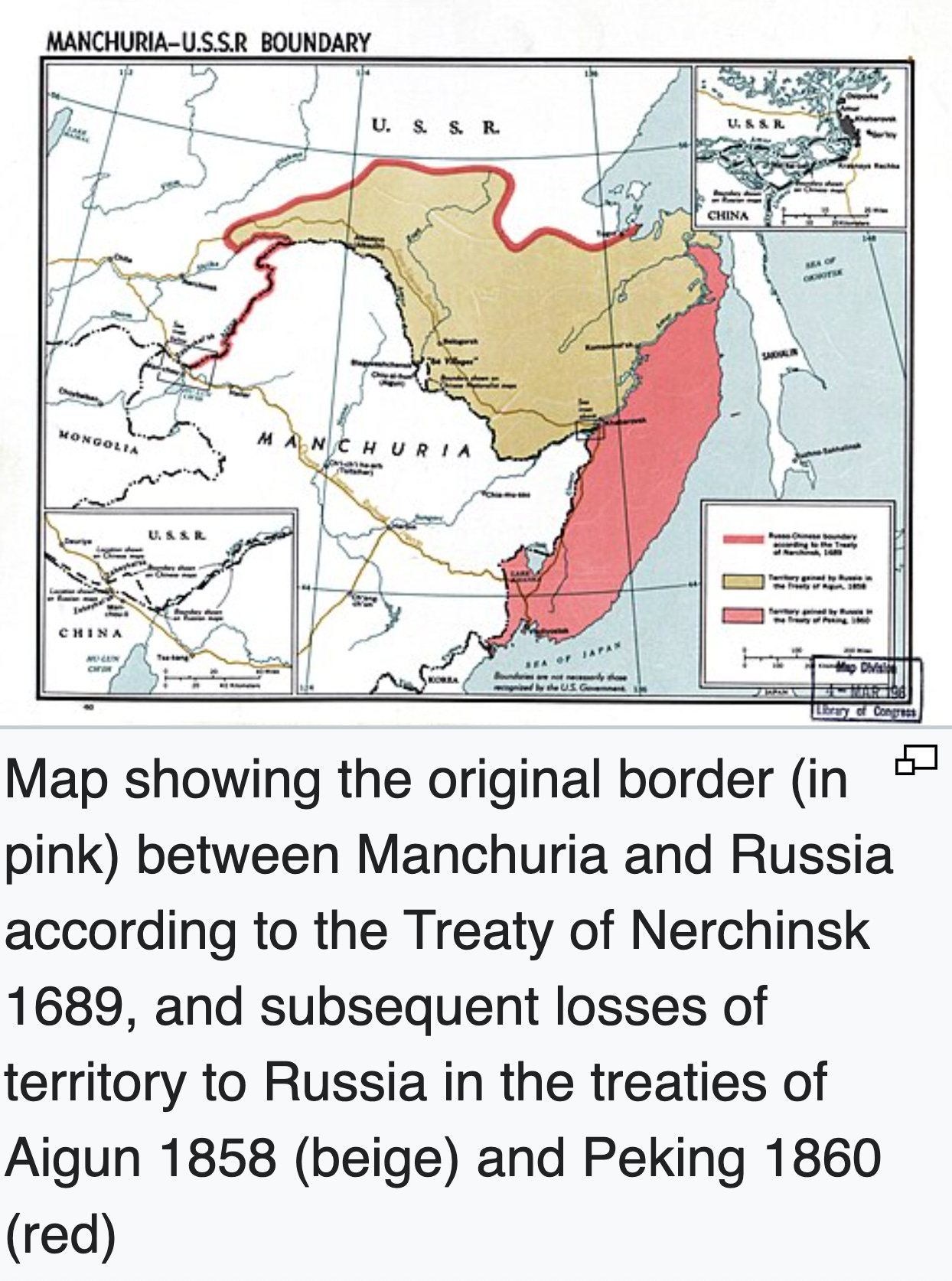
PPS. Dongbei literally means eastnorth, although of course English speakers would say northeast, the part of China where Manchuria is located.
Some of these comparisons seem to be confusing cause and effect, or at least implying that they would've happened anyways. Mafia influence, teenage pregnancy and maybe even terrorism went down because of concerted efforts to bring those down. The panics probably helped those efforts get on track.
Moving to warmer climates seems like a natural consequence of more AC being readily available than in the past.
Apparently the incumbent president of Taiwan, William Lai, has been baiting Beijing for a while, by pointing out if the Chinese were *really* serious about reclaiming missing provinces, maybe they should invade Siberia first . . .