
The Great Forgetting
How motivated reasoning frames economic debates

Noah Smith has a very good post on development economics, which contains the following list:
The field of economics doesn’t lack for big ideas about why countries go from poverty to riches. These include:
Institutions: The idea that property rights, legal frameworks, and other systems of human organization are long-lasting (“sticky”) and are crucial for development
Geography: The idea that countries’ natural endowments — navigable waterways, farmland, proximity to other regions, etc. — determine which place gets rich
Human capital: The idea that skills — reading, math, etc. — and population health determine national income
Industrialism: Various theories about how promotion of manufacturing, export-led growth, the “development state”, industrial policy, and so on are the key to rapid development
Culture: The idea that countries grow because of a culture of progress, innovation, and openness to technology
Coordination failure: The theory that countries naturally grow rich as long as they don’t have any significant roadblocks to growth, so that development happens when you remove all of the roadblocks at once
Flying geese theory: The idea that growth naturally happens in a sequential pattern as some countries luckily get rich first and then invest in poor countries until those countries catch up
Economic liberalism: The notion that all you really need to grow is free markets and openness to trade
State capacity: The theory that strong, efficient states are crucial for growth
National cohesion: The idea that a populace who see themselves as one unified people will support the public goods and other policies necessary for growth
That’s just a small sample of the huge diversity of big ideas out there.
That seems like a good list, and I suspect that many of those factors play an important role. But I’m a lot older than Smith and I have a slightly different perspective on the issue. I see a sort of “Great Forgetting”, a tendency to ignore the lessons of history.
In particular, a number of the cases cited in Smith’s, including South Korea and Poland, were once highly controversial. Now both countries are viewed as major success stories. Along with thinking about why they might have been successful (I could imagine many possible reasons), it seems to me that it is worth thinking about the following questions:
Why were people once so pessimistic about these two economies?
Why do the people who were pessimistic often not admit they were wrong?
What can we learn from the fact that these countries did far better than expected?
Back in the 1960s, South Korea was poorer than much of sub-Saharan Africa:
The country’s per capita income in the early 1960s was lower than those of Haiti, Ethiopia, and Yemen and about 40% below India’s. With such a low-level income, domestic savings were negligible.
It was widely assumed by experts that Korea would continue to be poor in the decades to come, due to overpopulation and a lack of natural resources. That seems like a pretty bad prediction, doesn’t it?

South Korea was criticized for adopting a policy of export-led growth in the 1960s. Many experts suggested that it should instead stick with its original “industrial policy” that focused on import substitution—the sort of policy used by Argentina (a vastly richer country at the time.) Fortunately, it did not:
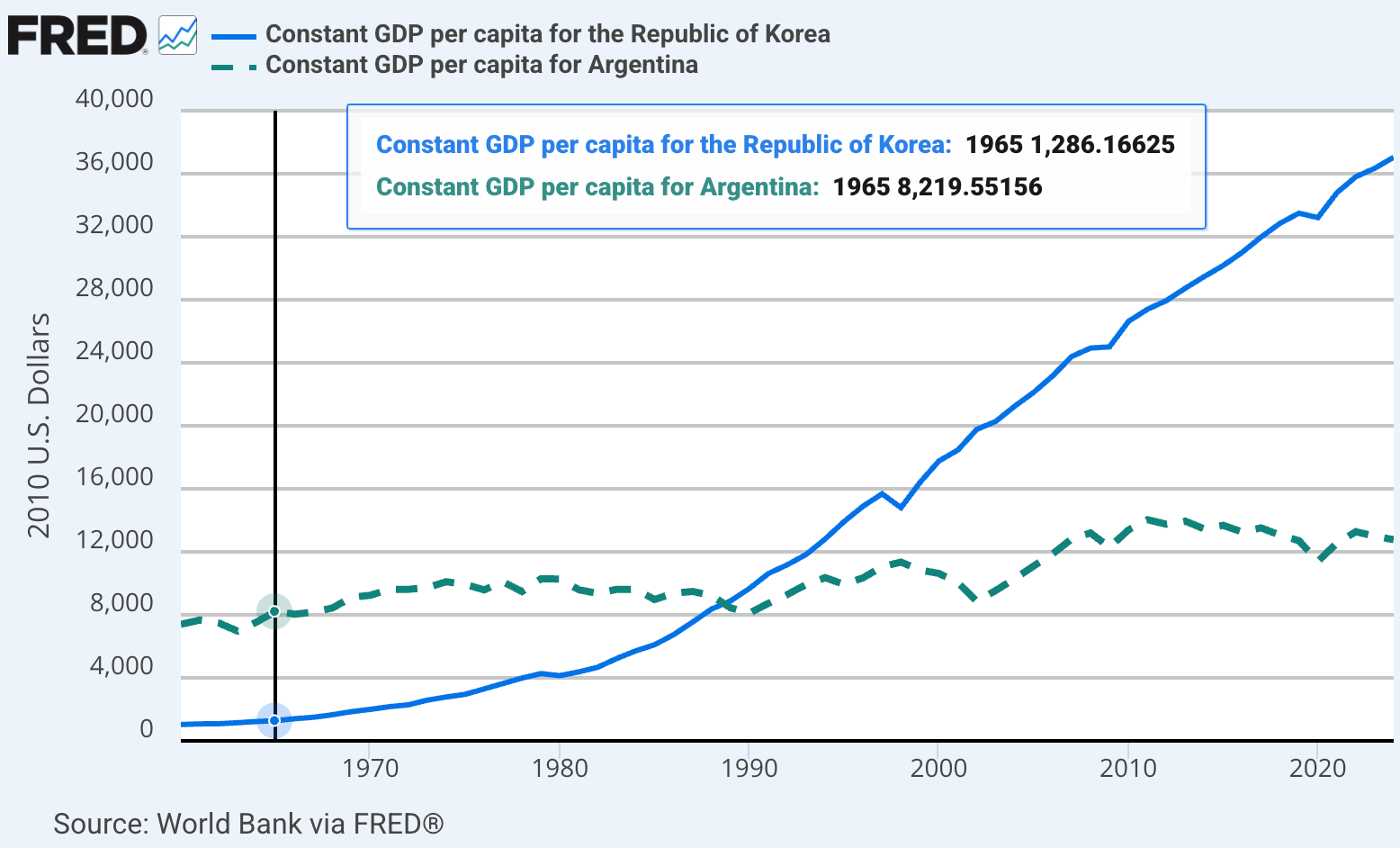
Back in 1989, Poland was severely criticized for what was derisively called “shock therapy”, “disaster capitalism”, or “neoliberalism”. In the end, Poland ended up being far more successful than most former Soviet bloc nations that pursued a more gradual path of reform. It seems like there are lessons to be learned in this case, but I don’t recall ever seeing one of Poland’s critics admitting that they were wrong.
While Smith’s post is certainly perfectly fine in terms of the issues he does cover, I worry that his younger readers may not be aware of the history that I just outlined. And without knowing this history, it is difficult to get a full picture of the issues at stake.
Here’s Smith on South Korea:
Why did South Korea grow so much more than Bolivia from the 1960s through the 2010s? The divergence is certainly startling:
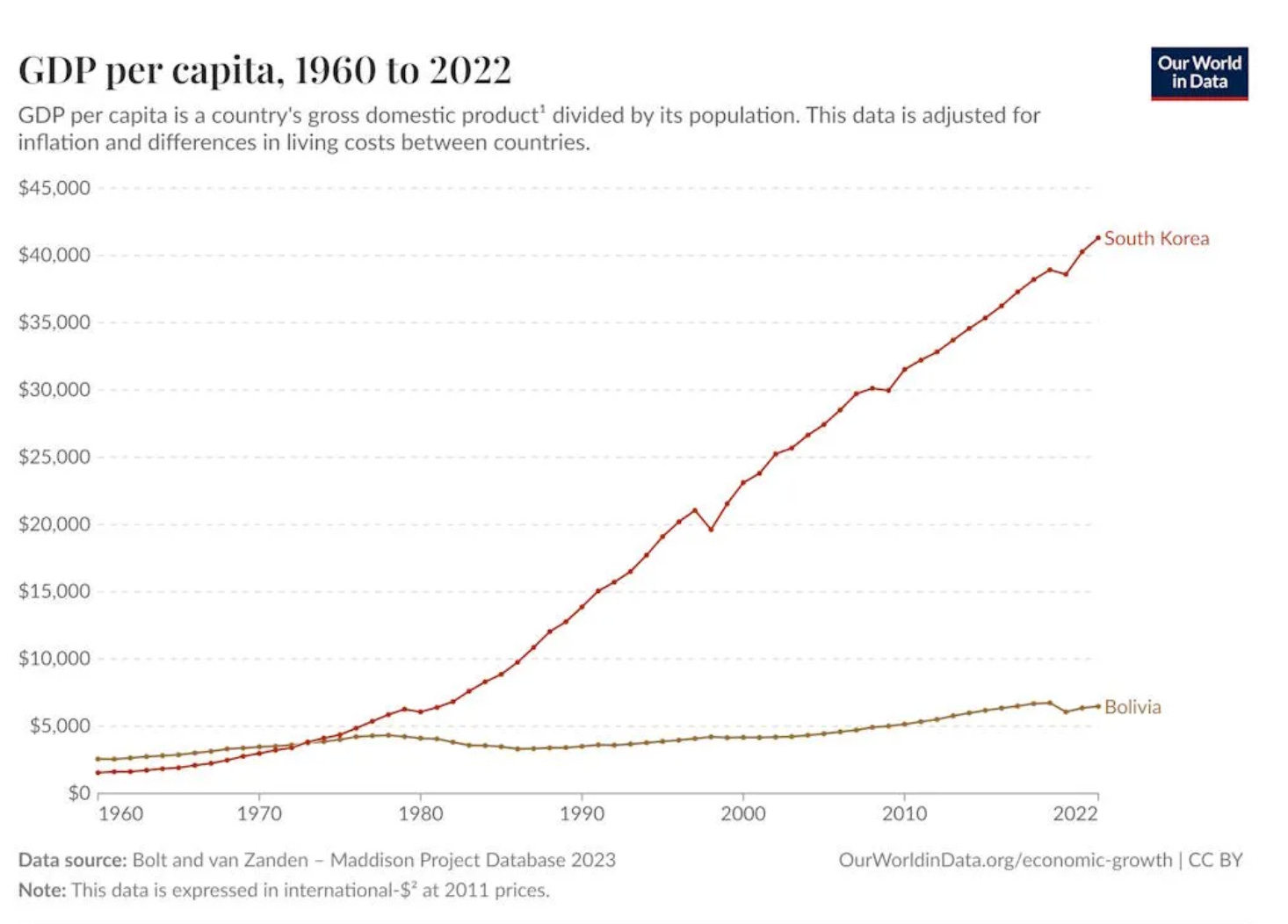
But this is an event that only happened once. There were a lot of differences between South Korea and Bolivia during this time, and it’s hard to know which ones were decisive. South Korea was much more highly educated than Bolivia in the 60s, despite its poverty. While Bolivia focused on selling its natural resources for as high a price as possible, South Korea focused on exporting manufactured goods and climbing up the value chain. Korea had a special relationship with the U.S. that provided it with a large, friendly, reliable market for its manufactured products, as well as government procurement contracts, aid, and technological assistance. Korea is ethnically homogeneous and has many centuries of history as a country with its own language; Bolivia is an ethnically diverse post-colonial state. Korea had a strong, professionalized bureaucracy; Bolivia, not so much. Korea has plenty of sea access; Bolivia is landlocked. Korea got to take advantage of Japanese know-how when its companies paid retired Japanese engineers to come teach their own workers; Bolivia had no such advantage. South Korea had to develop in order to ward off the military threat from North Korea; Bolivia had no such pressing imperative.
And so on. Depending on which Big Theory you believe, you could attribute Korea’s relative success to any combination of these natural advantages and policy choices. You could also tell a composite story — for example, in my own assessment of Poland’s economic miracle, I attributed the country’s breakout success to a combination of geography (proximity to the EU), institutions (changes made in order to be admitted to the EU), industrialism (promotion of manufactured exports and FDI), and flying geese (investment from Germany). I could have also mentioned high human capital, ethnolinguistic homogeneity, and the military threat from Russia. This makes for a good story — and you can call Poland’s success a “model” and try to emulate as much of it as you can — but it’s not a scientific explanation.
Smith is correct. Given the complexity of the situation, it is hard to know exactly why South Korea has been so successful. At the same time, we have lots of information from other sources that bears on this question. To begin with, let’s consider whether Bolivia is the best comparison country. Why not pick a country that shares some similarities with South Korea, to better isolate the effect of a few distinctive factors? After all, Bolivia and South Korea seem quite different along a wide range of dimensions.
If you compared South Korea with much poorer North Korea, you could rule out factors that also apply to the North such as culture, educational level, having a seaport, etc. Or you could compare South Korea to a place like Taiwan, which (unlike North Korea) has achieved similar economic success. In that case, we might be skeptical of any explanations for South Korea’s success that do not apply to Taiwan.
To be clear, I am not suggesting that these sorts of comparisons are definitive. Indeed, I suspect that education/IQ/culture does play an important role, despite the fact that the South Korea/North Korea comparison might suggest otherwise. I suspect that many factors play a role in economic development.
Despite the complexity of the problem, I feel like we know at least a bit more about South Korea’s success than implied by Smith’s discussion. For instance, Korea did poorly for about 12 years after the war, and then their economy took off like a rocket after the foreign trade sector was partially (not completely!) liberalized in the 1960s.
When I was young, the South Korean model was generally lumped in with places like Taiwan, Singapore and Hong Kong as a case of “export-led growth”. Even in the early 1970s, South Korea was still poorer than the North. There was no consensus that East Asia would do better than Latin America (or indeed that America would do better than the Soviet Union.)
I hate the term “export-led growth”, as on its face it would seem to imply that South Korea got rich by running trade surpluses. But exactly the opposite is true. During the three and a half decades of near double-digit growth (roughly 1963-97), Korea ran almost nonstop trade deficits, apart from a few years in the 1980s. This graph is from an excellent Doug Irwin paper that discusses the Korean reforms of 1964-65:
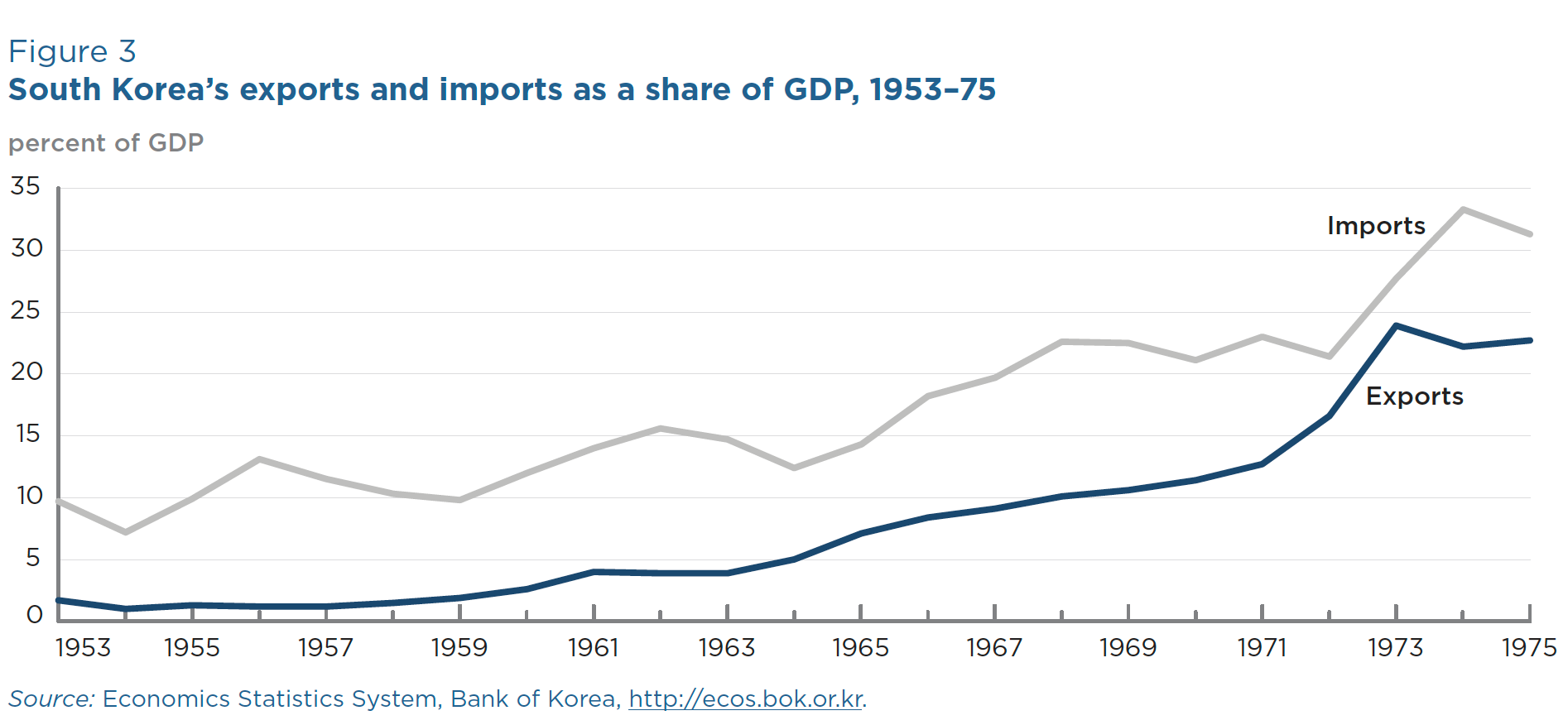
Notice how the trade deficit widened for a few years after 1965. I suppose it’s acceptable to call this “export led growth”—exports did rise—but in my view the term “trade-led growth” or an “open economy model” is more descriptive.
To be sure, this was a relative opening up—Korea maintained high import tariffs on many consumer goods for a considerable period. So, I’m not arguing that Korea had the sort of free trade regime that existed in places like Hong Kong. Nonetheless, if imports rise from 10% of GDP to over 30% of GDP in just a few years, it is hard to argue that it hasn’t moved at least somewhat in the direction of a more open economy.
I would argue that we do know quite a bit about South Korea’s success. Before making my pitch, however, I’d like to briefly discuss Malaysia, another success story highlighted by Smith in another excellent post (from 2023):
But anyway, South Korea is not the only big development success story that we’ve seen in recent decades. Two others that are almost as impressive are Poland and Malaysia, which are now on the cusp of developed-country status. Here’s a picture of how they stack up, with China thrown in as well:
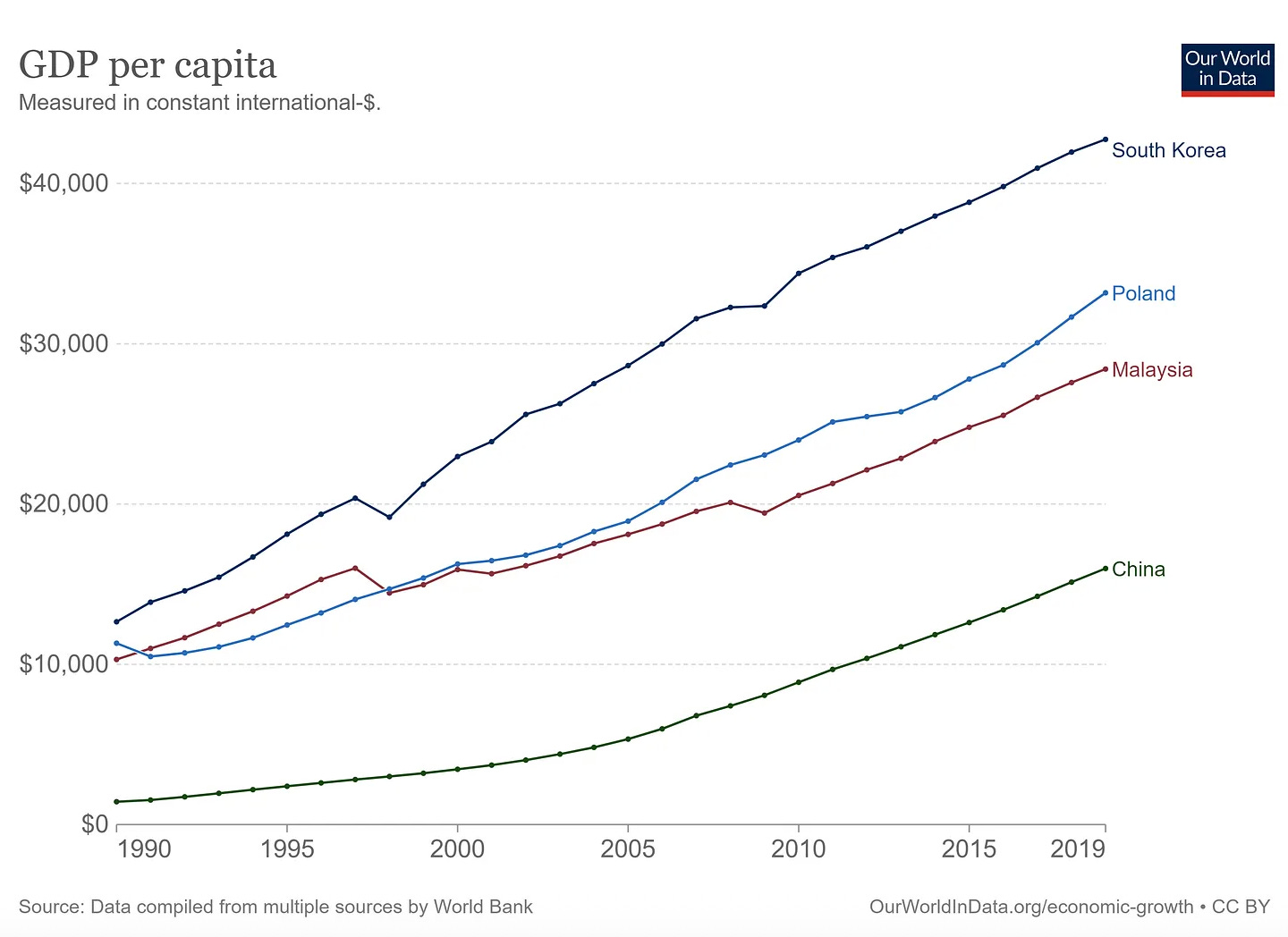
According to the IMF, in 2026 Poland’s GDP per capita (in PPP terms) will exceed the levels of Japan, Spain and New Zealand. It is no longer a developing country.
Smith sees manufacturing success as something that Poland and Malaysia have in common. But he also noted an important difference from South Korea:
Unlike South Korea, they relied heavily on foreign direct investment.
Before addressing this issue, I’d like to briefly discuss demography. A 2019 LSE article suggests that Malaysia has an unusual ethic mix:
The largest ethnic group in the country is Bumiputera, a Malaysian term describing Malays and other indigenous peoples of Southeast Asia — it literally translates as son of the soil. In 2016, the population consists of approximately 68 per cent Bumiputera, 24 per cent Chinese, 7 per cent Indian, and 1 per cent others.
Throughout Southeast Asia, per capita income of a country is strongly correlated with the share of the population from a “Confucian” culture (basically Chinese, Korean, Japanese, and Vietnamese.)
In much of the developing world, economic power is largely concentrated in the hands of a “market-dominant” ethnic minority. The classic case is southeast Asia, where the Chinese, usually a tiny proportion of the population, enjoy an overwhelmingly dominant economic position. In Malaysia, the average Chinese household had 1.9 times as much wealth as the Bumiputera (Khalid 2007); in the Philippines, the Chinese account for 1 per cent of the population and well over half the wealth (Chua 2003). The same is true in varying degrees in Indonesia, Burma, Thailand, Laos, and Vietnam.
To be sure, mainland China, North Korea and Vietnam are all poorer than predicted by their ethnic make-up, but of course all three are ruled by a communist party.
Today, Confucian culture and a non-communist economic system is highly correlated with economic success—almost everywhere in the world. The reason that Malaysia is so revealing is that it has the largest share of ethnic Chinese of any country that is not majority Chinese. Both the fact that Malaysia is much richer than other Southeast Asian nations, and that fact that the Chinese residents of Malaysia are much richer than the (majority) Malay residents is quite significant.
So, we know at least two important things about South Korea:
It has the sort of Confucian culture that is relatively rich in any country not ruled by communists.
It was very poor in the early 1960s and grew rapidly after adopting a trade-oriented growth policy.
Of course one could cite many other reasons for Korea’s success, including land reform, foreign aid, being allied to the US, industrial policies, etc. But none of the other factors seem as powerful as the two points listed above. Lots of countries remain desperately poor despite large amounts of foreign aid. Lots of countries trade with the US and are political allies. Several other East Asian economies got even richer than Korea without many of the specific industrial policies cited by proponents of the “Korean model”.
And what exactly is the Korean model? It depends on who you ask. I’ve just said that I view it as Confucian culture plus avoiding communism plus trade-oriented development, but your mileage may vary. In his 2023 post, Smith correctly criticizes the view that South Korea’s success is necessarily due to policies that banned foreign direct investment:
The generally acknowledged development champion of the modern world is South Korea. Joe Studwell, the author of How Asia Works, uses Korea as his paradigmatic success story, as does the economist Ha-Joon Chang (who grew up there). Chang and Studwell’s ideas have forced mainstream economists to take another look at industrial policy — in particular, at the idea that poor countries should promote manufactured exports in order to raise their productivity levels. . . . Ha-Joon Chang and some other industrial policy fans think that FDI is not the basis of a sound development strategy. Chang has gone to great lengths to show that today’s rich countries — the U.S., Japan, and so on — restricted or even banned FDI during their early stages of development. But that doesn’t tell us why it’s bad, or even if it’s bad; the rich countries could have succeeded in spite of this policy.
Here’s how I think about “industrial policies” that restrict the free market. If we look at Maoist China and modern North Korea, we see countries where the government allowed almost no free market, with an economy mostly closed to the rest of the world. No one disputes that modern China and South Korea are vastly richer and more successful than Maoist China and North Korea. No one disputes that modern China and South Korea also allow a far greater role for the private sector and are far more open to international trade and investment.
Consider an economy that is highly dysfunctional due to regulations that restrict the private sector. Now ask yourself the following question: How likely is it that a country that got rich after removing many of those restrictions on the private sector, reducing the role of the state, achieved its success precisely because of the remaining restrictions? Is that the first place you’d look? Especially given that there are even richer places in the same part of the world that lack most of those those restrictions of trade and investment (i.e. Singapore and Hong Kong.) Isn’t it more likely that the economy became rich by removing the sort of barriers to wealth creation that hobbled the economies of Maoist China and modern North Korea?
And yet I frequently see people trying to “explain” China’s amazing success (and let’s not forget that the PRC’s residents remain the poorest ethnic Chinese on the planet) by pointing to the CCP’s remaining interventions in the economy! That’s a logical possibility, but I have yet to see a shred of evidence for this claim. After all, China’s growth has been fastest during precisely those periods when reforms allowed a much bigger role for the private sector and opened the economy to international trade and investment. And its private sector is far more efficient than its SOEs.
Poland’s shock therapy approach of 1989 was adopted by a post-communist government that relied heavily on the advice of Jeffrey Sachs. This is from a 1994 paper by Sachs:
As the economic advisor to the Solidarity movement in Poland in 1989, I urged Poland to undertake a rapid transition to “normal” capitalism, on the model of Western Europe. When the first post-Communist government in Poland came to power in August 1989, the new economic leader, Deputy Prime Minister Leszek Balcerowica, adopted a radical strategy for the rapid transformation of Poland to a market economy. This strategy has subsequently won the somewhat misleading sobriquet of “shock therapy.” The strategy has been widely debated since its inception in Poland on January 1, 1990. . . .
With five years of experience of economic reform in Eastern Europe, the strategy can be more clearly understood and evaluated. The strategy seems to be winning the test of time. Not only have the early “shock therapy” countries — especially Poland and the Czech Republic — outperformed most of the other countries, but the idea of radical, comprehensive transformation to a market economy is increasingly being adopted in countries that earlier shunned the strategy.
Unfortunately, even Sachs seems to have forgotten the lessons of shock therapy. In recent decades he has downplayed the role of bad governance in the developing world and instead suggested that massive foreign aid programs are the key to ending poverty. Here’s Wikipedia:
William Easterly, a professor of economics at New York University, reviewed The End of Poverty for the Washington Post, calling Sachs's poverty eradication plan "a sort of Great Leap Forward".[78] According to Easterly's cross-country statistical analysis in his book The White Man's Burden, from 1985 to 2006, "When we control both for initial poverty and for bad government, it is bad government that explains the slower growth. We cannot statistically discern any effect of initial poverty on subsequent growth once we control for bad government. This is still true if we limit the definition of bad government to corruption alone." Easterly deems the massive aid proposed by Sachs to be ineffective, as its effect will be hampered by bad governance and/or corruption.
By the late 1990s, it seemed like the debate over industrial policies was over. Trade-oriented growth in East Asia was clearly superior to import substitution in Latin America. Shock therapy was a success in Eastern Europe. And then after 2008, a sort of Great Forgetting began to take hold. All the lessons of history were forgotten. Americans elected a president who favored the Peronist model of crony capitalism and import substitution. The left began to re-embrace once discredited statist policies. And here we are . . .
The story of the 21st century is the Great Forgetting. We’ve forgotten the new Keynesian critique of activist fiscal policy. We’ve forgotten why nationalism is an evil ideology. We’ve forgotten the lessons of Orwell’s 1984. We’ve forgotten that statist economic policymaking is counterproductive. We’ve forgotten that integrity and competence are important attributes for a politician or media figure.
I’m about to start reading Hanania’s Kakistocracy. I hope he can explain to me why the world is getting dumber.
PS. If you believe that Argentina failed not because of its closed economy model, but rather due to its Latin American culture, check out a recent post by Constanza Mazzina:
Alberdi recognized that for a desert to become a nation, the law must act as a shield for property and a magnet for capital. He moved [Adam] Smith’s ideas from the realm of political economy to the realm of constitutional law, ensuring that the right to trade, produce, and possess was not a concession from the government, but a pre-existing right that the government was sworn to protect.
The synthesis of Smith’s theory and Alberdi’s law was the engine of the most rapid economic expansion in Argentina’s history. Between 1880 and 1914, Argentina became the world’s laboratory for Smith’s recipes. By following Smith’s advice on free trade and Alberdi’s constitutional guarantees, Argentina during this period achieved sustained annual growth rates that frequently exceeded 5 percent, a feat of consistency that was unmatched by almost any other Western economy at the time. This was not merely a quantitative increase in exports, but a qualitative leap in national standing. By the turn of the century, these institutional foundations had catapulted a fractured and impoverished territory into the ranks of the world’s ten wealthiest nations by GDP per capita, occasionally surpassing established powers like France, Germany, and even its former colonizer, Spain. This “Golden Age” was the empirical proof of Smith’s thesis: that the wealth of a nation is not a matter of luck or ancestral heritage, but the direct result of an institutional framework that protects the individual’s right to create, trade, and accumulate.
"Of course one could cite many other reasons for Korea’s success, including land reform, foreign aid, being allied to the US, industrial policies, etc. But none of the other factors seem as powerful as the two points listed above."
Being within the US security umbrella was the prerequisite, the effect of this-or-that domestic factor is swamped by that effect. This is why we can find so many "recipes," to use Rodrik's language. It prevented various forms of security-obsessed nationalisms (communist or otherwise) from taking hold, and eliminated the imperial competitions that diverted resources from development to state power. That is the common factor with Taiwan and Japan within the "Confucian" sub-unit, it is a common factor with Poland in Europe, and it is not common with places like sub-Saharan Africa or parts of Latam that never had consolidated communist regimes in power yet still didn't develop. It is also why China and Vietnam started liberalizing after rapproachment with the US, and stopped liberalizing since the US has turned against the open economy.
Inclusive domestic institutions are downstream of the security environment. The US structured global security over the past 75 years, and the US prioritized open markets, so if you were within the security environment you received the benefit of open markets. If you weren't it was much harder.
It's a real shame (from the perspective of world development) that the US security apparatus has become extractive, beginning with the Bush years. Over the past 25 years worldwide democracy has declined, press freedom has declined, corruption has increased, public trust has declined, and global growth rates have slowed. It's not a coincidence.
The open global economy was a cosmopolitan liberal project with progressive aims, not a libertarian project, nor a Confucian project, nor a statist project. But there seem to be no more cosmopolitan progressive liberals around anymore, other than Mark Carney.
Thanks for correcting a few misconceptions on my part. I had heard the case of Poland argued from the opposite position, with the framing relying exclusively on comparisons between Poland and post-Soviet Russia. Your analysis presents a far more rounded picture. On the industrial policy, do you think there is a specific exception for targeted industrial policy which is specific and encompasses an understanding of markets? Both South Korea and Singapore invested heavily in semiconductors. Are good industrial policies simply too difficult and multi-faceted for most governments with strong political factors to consider to accomplish? I know Germany and Japan in specific periods were cited in the original arguments against Friedman. I guess my question is: are they unlikely to work in most instances because Man of Systems requirements make them unobtainable to all but exceptional governments in exceptional periods?
A while back I looked at conditions for success for majority Muslim countries. Excluding the oil rich Gulf States, Turkey and Malaysia were the best success stories. Both operate a very threadbare and limited version of Sharia Law, mostly relating to personal and family law for Muslims.