

I’ve recently seen a great deal of commentary on the question of values. Is everyone in the world equally important? Or should we favor those close to us?
The answer to both questions is yes. To better understand this debate, we need to disentangle three separate issues:
Is everyone’s welfare equally important?
Are people naturally selfish?
What is the best way to organize society?
Throughout history, the greatest philosophers have understood that the welfare of all people is equally valuable, in an absolute sense. This is so obvious that I hope I don’t need to explain the concept to anyone. We may not care about someone living on the other side of the world, but they have family and friends that care about them just as much as we care about our family and friends.
This sort of universalism does not imply we must devote equal resources to each person. We should devote more resources to saving the life of a baby than saving the life of a 90-year old man. That’s why I say everyone’s “welfare” is equally important, not everyone’s life. The baby has more potential welfare. In my view, the best world is the one that maximizes aggregate welfare. But even if you reject my utilitarianism, there is no defensible value system that says the people I know are more important than the people I don’t know. That’s just dumb.
On the other hand, it’s perfectly reasonable to say the people I know are more important to me than the people I don’t know. That leads me to my second point—we are all selfish, at least to some extent. Most people favor their own welfare over the welfare of others, and favor the welfare of friends and family over the welfare of strangers. Many of us favor the welfare of strangers in our own country over the welfare of strangers in another country. I’m tempted to say that that bias is natural, although the term ‘natural’ could mean cultural, genetic, or both. (My hunch is that it’s both, but that distinction is not important for this post.)
So far we have a sort of dilemma. The welfare of every human being is equally important, and yet because we are selfish we tend to favor the welfare of some people over the welfare of others. Is there anyway to reconcile these two facts?
The importance of solidarity and cohesion
Jesus taught universal values to his followers. But most people find that goal to be unreasonable. Even most Christians don’t really believe in what Jesus said:
25 Many people were traveling with Jesus. He said to them, 26 “If you come to me but will not leave your family, you cannot be my follower. You must love me more than your father, mother, wife, children, brothers, and sisters—even more than your own life! 27 Whoever will not carry the cross that is given to them when they follow me cannot be my follower.
Hmmm, how about if I just leave a few dollars in the plate they pass around in church?
Seriously, I’ve always been impressed by the radical nature of Jesus’s teaching. I will not try to interpret what Jesus meant, rather I’ll try to resolve this dilemma by bringing in a third factor, beyond universal values and beyond narrow selfishness. That third factor is the organization of society, the question of how to arrange things so that people work together in an effective manner.
The easiest place to start is with the family, because babies come into the world with no ability to take care of themselves. Without some altruism toward the young, human society would quickly become extinct. I’m not sure how Jesus thought of this question, but in my view a reasonable way of squaring the circle is as follows:
The family is a very useful social unit for all sorts of purposes, especially the raising of children. This means that many people will choose to devote more effort to helping family members than they would to helping strangers. Global aggregate utility will be higher in a world where people at least slightly favor family members over strangers, but we should never lose sight of that fact that this favoritism is instrumental, and that our ultimate values should always be universal. It’s natural for you to love your son or daughter more than a stranger’s child, and devote more resources to helping them. They are more important to you. But never lose sight of the fact that they are not more important in an absolute sense.
The family is not the only important social unit. It is also useful to have schools, businesses, unions, religious organizations, sports teams, military units, and other forms of social organization. Society works better if you favor people within your own social unit, as this builds group solidarity.
Nonetheless, this allegiance should not be blind. There should be no “My country, right or wrong.” Germans should not have fought to defend their country in WWII. That’s not to say I might not have fought in the German army in WWII, but it would have been because I was a coward, not because I thought it was the right thing to do.
Our solidarity with various groups is always instrumental, never an ultimate value. The ultimate value is human welfare. The German invasion of France in 1940 did not promote human welfare. The Allied invasion of France in 1944 did promote human welfare.
I mention warfare because the nation is a different type of unit from a family, school, business or church. Nations exist because the world is still somewhat barbaric, somewhat uncivilized. Not all of the world, but a significant enough part of the world so that nations are seen as being essential.
Europe is now civilized. Europe still has nation states, but mostly because they are seen as a necessity in a world where other countries have not yet become civilized. The nation state is seen as a way of protecting the public from invasion. But within Europe, especially Western Europe, fear of invasion has basically disappeared. WWII had the effect of discrediting militaristic nationalism, and a European Union was set up to promote international cohesion, international solidarity. Europe is where Fukuyama’s “end of history” has come true.
If the rest of the world were to disappear and only Western Europe remained, the nation state would probably wither away. Other forms of social organization would remain, such as families, business and schools. There would even be local governments to provide public services. But it would feel more like the difference between Indiana and Illinois, not the difference between the US and Canada. Patriotism would be like rooting for the Eagles over the Chiefs.
Patriotism is sort of like the military. It is often a useful thing, but only because we live in a highly uncivilized world. Europe is probably the least patriotic part of the world, because it’s the most civilized.
Now let’s apply this to a few public policies, starting with tariffs:
Tariffs are beneficial to firms that compete with imports, and harmful to exporting firms as well as firms that don’t engage in trade. Overall, tariffs reduce national welfare. Thus tariffs are an easy case. Promotion of tariffs is unpatriotic, and they also reduce global welfare.
Foreign aid is a trickier case. There may be some foreign aid programs that boost global welfare but reduce national welfare. The more generous a country, the more resources they are willing to devote to foreign aid. Is there an argument that “charity begins at home”? Yes, but it’s not the argument that is usually cited. We should only favor domestic charity if doing so boosts aggregate global welfare. That requires some explanation.
Let’s go back to the idea that the entire world benefits if there are useful social groups such as families, businesses, schools, and (unfortunately for now) even nations. To be effective, these social groups require a certain degree of social cohesion, or solidarity.
Here’s where things get confusing. Think about the following three levels:
The individual
The group
The world
There is a certain tension at the intermediate level of the group. Group cohesion requires individuals to be at least somewhat altruistic, putting the interest of the entire group ahead of the individual member of the group. But groups often behave in a selfish manner, putting the interest of the group ahead of the interest of the world. This distinction largely explains why you see various pundits on the internet floundering around, trying to reconcile seemingly conflicting moral intuitions: “Obviously, everyone is equally valuable”, but also “Obviously, we should first help those closest to us.”
The only way to resolve this dilemma is to see groups as being instrumental, not ends in themselves. Then we need to answer two questions:
How much group cohesion is necessary to maximize global welfare?
How much local favoritism is necessary to promote group solidarity?
That will vary on a case-by-case basis. Bill Gates can give vast sums of money to charity, and still have enough left over to provide lavish support for his children. Norway can maintain useful national cohesion while donating a bigger share of national income to foreign aid than does Greece.
To be clear, I do not expect individuals or groups to behave in the way that I recommend. Even I don’t behave that way—because I’m somewhat selfish. Most of us favor ourselves and those close to us more than is strictly necessary for maintaining group cohesion. No one ever suggested it was easy to follow the teaching of Jesus. (How often do you see people turn the other cheek?)
But while natural selfishness makes the implementation of universal values to be an impossible ideal, at least we can try to develop a moral framework that clarifies the issues. To summarize:
Universal values are ideal.
Local social groups are useful, even essential for global welfare.
Some local favoritism is useful for promoting the solidarity required to maintain cohesive social units.
Don’t make support for those local social units an end in itself—they are instrumental in promoting universal values.
One final point. This post is focused on how to think about public policy issues. I certainly don’t expect people to engage in such cold rational thinking when buying birthday presents for a child. That would be inhuman. Evolution gave us emotions like love so that we’d do a certain amount of this social cohesion almost instinctively.
Here’s Jesus portrayed in Caravaggio’s Supper at Emmaus:
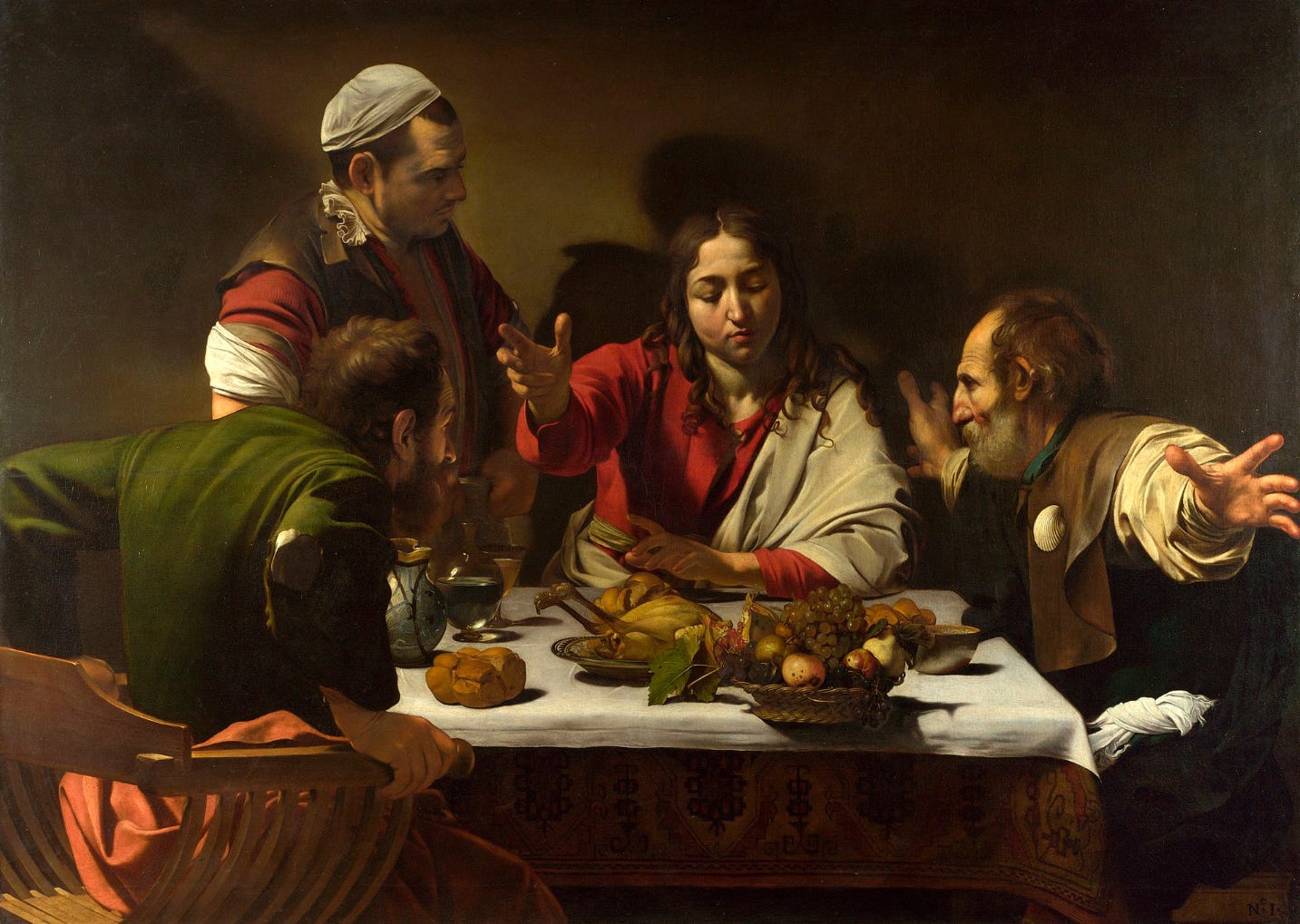
Wake me up when AI art can do that.
I have enjoyed the recent forays into moral philosophy. I wonder if this post grapples enough with our moral intuitions about the people with whom we are in relationship.
Suppose my brother has lost his job and is struggling to make ends meet (but is not starving or homeless). The aggregate global welfare gains from any money I give him are dwarfed by the gains from giving the money to GiveWell (even accounting for the second-order effects on societal organization).
Lots of people share the intuition that it would be wrong to donate to GiveWell and neglect my brother in this case. Would you "bite the bullet" and say this intuition is just selfish bias?
This is an interesting post Scott. In fact, it mirrors much of the commentary on Matt 10:37 (and related passages like in Luke 14:26, which is actually the more jarring version of this message) by the church fathers. We see this in Jerome, Chrysostom, Gregory… but Aquinas (as usual), I think systematizes it best.
A Christian is called to order love with the highest good (I.e. God) at the top. That is, if a conflict arises between the call (or will perhaps) of God and the will of our earthly relatives, we must choose Gods will as it’s higher in the hierarchy.
The love of family flows through the love of God. The family and closer groups are where we learn to be considerate and generous and sacrificial. These things we were given by God to care for, so our priority is on those who are closest to us… My role as a father is to care and sacrifice, first for my family, as it’s been entrusted to me. Then to the local group, then to the rest… but we must resist making this an idol.
We love our family and closer groups through Christ… that is we love them because we were made to love them and have been given them as a gift to care for in order that they become care givers and workers in the vineyard themselves. However, if push comes to shove, we must remember that the higher allegiance is to that of God. If there a conflict between the will of our father or mother or nation and the will of God (say fighting for an evil empire), we must choose God, pick up our cross and accept the consequences. We must not be cowards (though I too question how I would respond if actually in that spot).
It’s like as a father, if there is a bullet to be taken for the family… that bullet is taken by the father… as that is the hierarchy of how things flow.
I write this because what you have written is entirely consistent with a Christian framework and those Christians out there on the right might need to be reminded to consider who it is that their highest allegiance is to be oriented towards.
Thank you for this post.