
Odds and ends
What I've been reading

The OC Register reports that the gods are angry with Disney:
ORLANDO, Fla. (AP) — A Walt Disney World worker in Florida was injured while attempting to stop a large runaway prop boulder from rolling into seated spectators at the Indiana Jones live show.
The worker at the “Indiana Jones Epic Stunt Spectacular” at the Disney’s Hollywood Studios park was knocked to the ground by the 400-pound prop boulder after it moved off its track on Tuesday and started rolling toward audience members. Another worker stopped the boulder before it reached the spectators.
“But Trump achieved Operation Warp Speed in his first term.” File that under the accuracy of broken clocks:
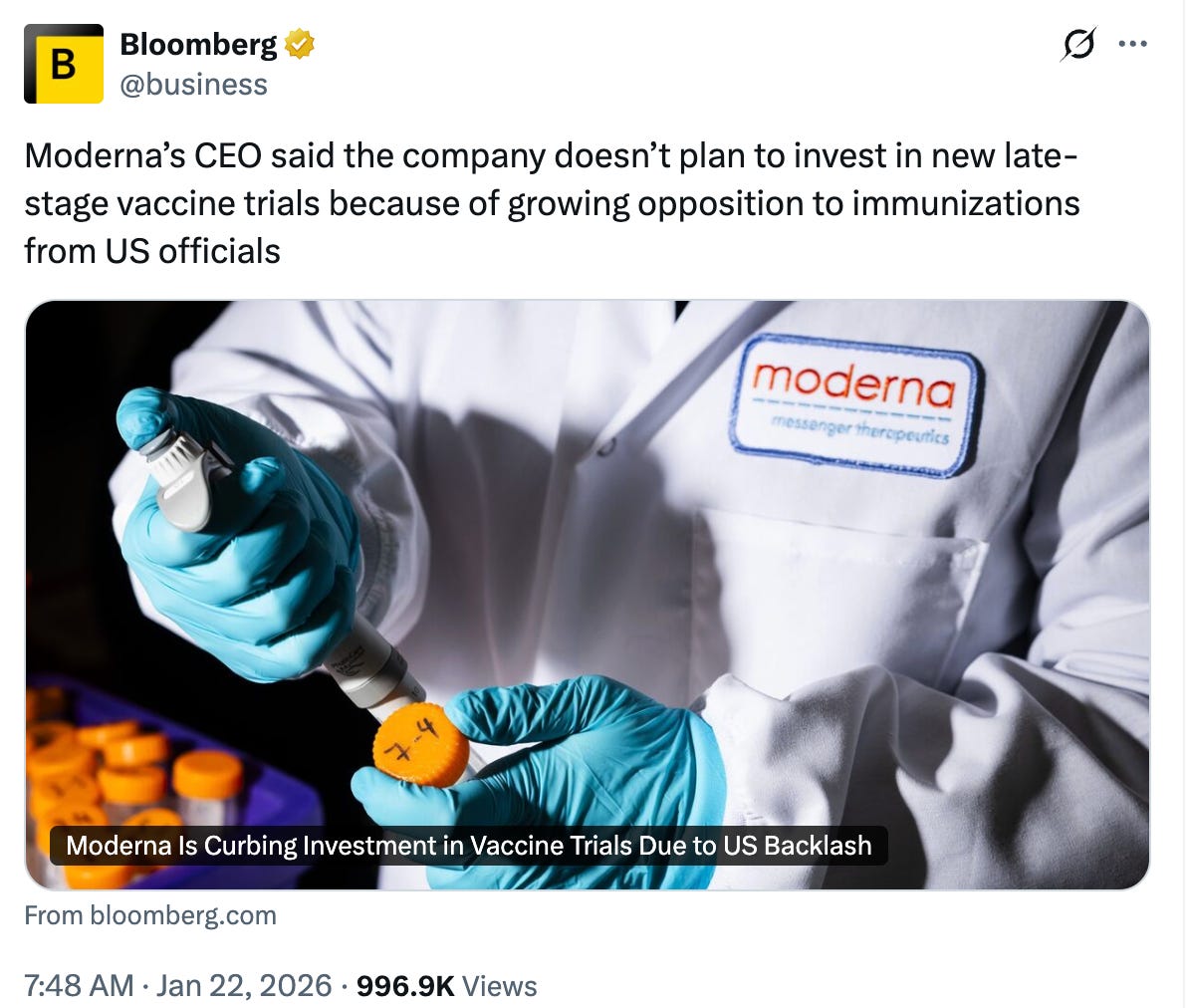
I’ve often wondered how long it would be before the global political re-alignment that we are seeing begins to impact the economic policy views of the various political parties. The Economist has an interesting piece on “low-tax lefties”:
On the left, tax has turned from a fundamental bargain with the state to a cost-of-living issue. Why should young grumpy professionals who dominate the British left pay more when they receive so little? “Nick, 30 ans”, a French meme about an overtaxed young professional, is beloved by the online right in Britain, who assume that fed up yuppies will flock to the right for lower taxes. Run this demographic through a pollster’s table and it soon becomes clear “Nick” probably voted Labour at the last election. Would he still, if Labour put up his taxes? “Cut bills, tax billionaires,” says Mr Polanski. After all, “Nick” is not a billionaire.
Back in 2008 I wrote a paper entitled The Great Danes. Ever since then, I’ve been obsessed with Denmark (a country I’ve never visited.) This caught my eye:
On December 30th PostNord will take things further: after 400 years, it will end its collection and delivery of letters entirely.
Denmark will be the first European country to do so.
And on a less positive note, this one too:
In Britain, natives and foreign-born people have almost identical employment rates, and migrant employees earn more. In Denmark, by contrast, natives are employed at substantially higher rates than immigrants or their descendants. The PISA education tests carried out by the oecd, a club of mostly rich countries, show that the children of migrants fare poorly in Denmark and well in Britain (see chart 2). Indeed, migrants’ children in Britain score higher in both maths and reading than native Danes.
The two countries have different immigration traditions. Like many European countries, Denmark opened its labour market to “guest workers” in the 1960s, implying that anyone who arrived was temporary. Britain drew from its current and former colonies. Although Commonwealth migrants suffered appalling racism, they clung to the view that they were fully British, and eventually ground almost all white Britons into agreeing.
Much of the world (including the US) is moving away from neoliberalism. The Vietnamese have a better idea:
In May, Vietnam issued Resolution 68, recasting the private sector as “the most important driving force” of the economy and aiming to boost its size. The new law promises easier access to land, capital and regulatory permissions for private firms. It aims to empower smaller businesses, as well as spurring conglomerates to compete abroad. A range of other initiatives are in motion, too, from supercharging Vietnam’s r&d capacity to transforming the port city of Da Nang into a global financial hub.
Perhaps most importantly, Mr Lam has directed Vietnam’s bureaucrats to move with haste. Too often in the past their aversion to risk has stood in the way of dynamism. He has abolished five ministries and eliminated an entire layer of the bureaucracy. He is reducing the number of provinces from 63 to 34. The civil service is set to shrink by 100,000 jobs.
In contrast, American economic policy (under both Biden and Trump) is weakening the hand of China’s neoliberals:
China is confident of its leverage over America. That swagger is hard for trade partners to take. But its intransigence has still deeper roots. China’s rulers like their plan to dominate the commanding heights of global manufacturing, and do not wish to change.
Reform-minded Chinese share foreigners’ fears that this manufacturing drive is unsustainable. But party bosses see Mr Trump’s adoption of Chinese-style industrial policies, including government demands for stakes in leading companies, as an endorsement of their own approach. Equally, they feel vindicated in their obsession with self-reliance. Their distrust of America is now near-total, after Mr Trump’s attempts to choke off China’s access to American technologies, interspersed with campaigns to sell China more of them. America “made a huge mistake”, says the Chinese economist. It “woke up China”, but could not prevent the country from developing world-beating industries.
Mr Trump came to power promising a manufacturing boom for the ages. It would be awkward if he succeeds, but in China.
Iraq still has major problems, but an article in the Economist suggests that things are getting better:
[Mr Sudani] oversees powerful investment committees that can swiftly approve projects. “What we used to do in a year or two, they can now do in one sitting,” says Namir al-Akabi, chairman of Amwaj, one of Iraq’s largest real-estate firms, which is throwing up apartment blocks across Baghdad.
Progress goes beyond the capital. Mr Sudani has digitised many government services. The passport office in Baghdad issues new travel documents within 45 minutes; officials claim they are the fastest in the world. Until 2023, annual customs income had never exceeded 900bn Iraqi dinars ($690m). This year it is expected to exceed 3trn dinars. The days of dodging fees by importing containers of iPhones as bananas are over, thanks to digitisation, says one un official.
Government salaries are no longer paid in cash. Payments for government services, such as those speedy new passports, can be made only with a bank card. Five years ago almost no one in Iraq had one; today they are essential.
Morocco has recently adopted a number of economic reforms, which seem to be paying off:
The results include a high-speed train that runs up the country’s west coast. On the road into Tanger Med, drivers pass endless wind and solar farms, as well as special economic zones ready to welcome investment.
Perhaps the biggest draw for European firms is a free-trade agreement that was struck with the EU in 2000. Preferential deals with 60 other countries have followed. This drew big investments by carmakers such as Renault and later Stellantis . . .
Last year Morocco became the biggest exporter of cars and parts to Europe, surpassing China and Japan.
Morocco is a manufacturing powerhouse? Who knew?
In some cases, Trump is indirectly pushing other countries in a positive direction. Here’s the Economist:
When it comes to the bilateral relationship, Mr Carney acknowledges Mr Trump’s oft-repeated claim that the United States “has the cards”. But he insists that there is “not just one game” and that Canada is “going to play other games with other players”. He has cut taxes and simplified regulation to foster an infrastructure boom at home; he says he will double Canada’s rate of home-building; he is working to eliminate the significant trade barriers between Canada’s provinces. The other players are Europe and Asia, with which Mr Carney wants to expand trade dramatically. “We can give ourselves far more than the United States can take away,” says Mr Carney. . . .
Mr Carney also wants to get Canada “building infrastructure at a pace and a scale that we haven’t done for generations”. That includes oil pipelines, port expansion, electricity transmission lines, critical-mineral mines and, of course, housing. He has cancelled a planned rise in capital-gains tax and is “changing the way we do regulation in this economy so there’s much greater certainty”, in the hope of stimulating investment.
And India:
The European Union and India concluded a free-trade agreement after almost two decades of negotiations, part of an effort to deepen economic ties that has gained momentum due to the Trump administration’s aggressive tariff policies.
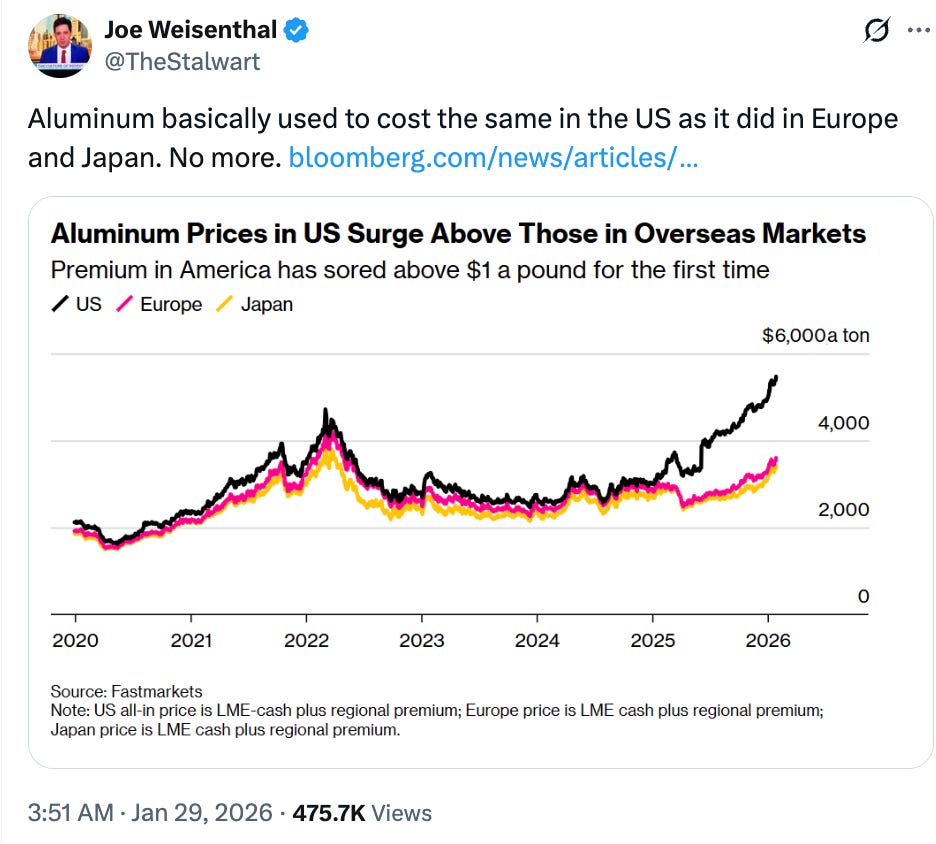
Tariffs are making the US a very expensive place to do manufacturing:
LOL:

California is losing population, but it’s not because lots of people are leaving the state. Instead, hardly anyone is moving here (except me in 2017.)
Note that 2.1% of Americans changed states in 2024. That same year, 1.7% of Californians left for other parts of the U.S. That below-average departure rate is also down from California’s 2% departure rate in 2021-23.
California is among the states with the most loyal residents. For 2024, only Michigan (1.3%), Ohio (1.5%), and Texas (1.6%) had smaller departure rates.
Oh, Florida’s exit rate was 2.2% of its population, ranking No. 30.
California is sort of like another country, where gasoline costs $5/gallon and a modest ranch house can cost $1 or $2 million. Just as people rarely move from one country to another, people rarely move in or out of California.
Left wingers: Don’t have whites play black roles.
Right wingers: Don’t have blacks play white roles.
Me: End identity politics. Become a colorblind society.
The Economist recently interviewed a bunch of patriotic MAGA-types who work at some of those innovative military tech companies in El Segundo, California. This caught my eye:
Asked why Neros does this in California, rather than in a more pro-business, pro-Pentagon state like Texas, he smiles mockingly. “The best engineers in the world don’t want to live in Texas,” he snorts.
If you wish to know what he’s talking about, check out this tweet.
Seeing this headline in the Free Press got me thinking about how the alt-right decides to assign different moral worth to different ethnic groups:
The Afrikaners Welcomed to America—and the Ukrainians Forced to Leave.
The media is obsessed with sex and violence, which is why there’s so much coverage of ICE killings and the Epstein files. Meanwhile, this story has attracted relatively little attention. (The National Review has more detailed information.)
The Economist has a good article explaining how Britain’s Reform party is beginning to adopt the issue positions of the Conservatives:
If the personnel are beginning to look similar, so is the governing philosophy. Britain’s fundamental problem is a lack of economic growth, which Reform has little intention of solving. The simplest policy prescriptions that would make Britain richer—making it easier to build, being open to foreign talent, making trade easier with Europe—are anathema to Reform, just as they were to the Tories. By the end of their tenure the Conservatives relied on elderly voters who had little interest in economic growth. Why should they? They will live through the upheaval yet not feel the benefit. Reform is repeating this. By 2024 the Tories were a right-wing party wedded to policies that will make Britain poorer. Come 2029 Reform will accept that mantle.
In recent weeks, the Economist has published a series of articles suggesting that alcohol may have helped to create the modern world:
Edward Slingerland of the University of British Columbia argues that alcohol was not merely a companion of progress but a precondition. His “drunk hypothesis”, proposed in 2021, is that alcohol’s effects on the human pre-frontal cortex drove the emergence of large-scale, stratified societies by allowing “fiercely tribal primates to co-operate with strangers”. Human societies are so complex, and depend so much on creativity and the cultural transmission of knowledge, that humans could not have built civilisation without first getting drunk enough to intermingle and co-operate to a degree that is unusual for other species.
A few weeks later they discussed another study:
It would be wrong to minimise the real health risks associated with drinking, particularly as researchers have raised serious doubts over earlier findings of a “J-shape curve” in which those who drink moderately were thought to be healthier than both heavy drinkers and those who abstain entirely. Even so, alcohol itself often provides the lubricant around which many people socialise. Researchers at the University of Oxford noted in a paper published in 2017 that regulars at a local pub are “more socially engaged, feel more contented in their lives, and are more likely to trust other members of their community”.
You won’t find this information at MarginalRevolution! Seriously, I’m not a drinker, but that’s for health reasons, not by choice. (I love the taste of wine.)
Unlike in the West, anti-immigrant attitudes in Japan are more common in urban areas:
[A]nti-foreigner turn risks setting the LDP further at odds with the many Japanese voters who still take a moderate position on immigration. Japan’s business leaders tend to favour policies aimed at expanding the number of foreign workers. And the governors of Japan’s 47 prefectures, worried by the tone of debates, recently banded together to issue a statement in support of multiculturalism. “Xenophobia must not be tolerated,” said the leader of their association.
Perhaps surprisingly, Japanese from the countryside tend to be more open to newcomers than urbanites. The reason is that labour shortages have hit rural areas hardest . . . “We’ll be in deep trouble if the foreigners stop coming here,” says Mizuno Daisuke, the boss of a fishing co-operative on the island of Shikoku. Half of his employees are Indonesian. “We should only be saying thanks.”
23. Isn’t this ironic?
Chinese firms are already hearing loud demands from European and other governments to transfer more advanced technologies to foreign partners, and to source more components from local supply chains. The European Union is debating “buy European” local-content rules for public procurement contracts, in a bid to give such demands some bite. Still, many Chinese businesses will try to keep their most valuable operations at home.
What would Michael Scott say?
This Economist story is worth thinking about:
In 2024 Brightline transported 2.8m people in Florida. But 41 people also died in accidents involving its trains, according to the Federal Railroad Administration (FRA). Its data excludes suicides. Since launching in 2018 over 180 people have been killed, including suicide cases, according to data collated by the Miami Herald. . . . By international standards, the death toll is astonishing. In the year to March 2025 Britain’s railways transported 1.7bn people and around a dozen people were killed on train tracks.
On a per trip basis, Brightline is more than 2000 times more dangerous. The per mile difference may be smaller but certainly wouldn’t explain this enormous difference. A small airline like Spirit Airlines carries 44 million passengers per year. Imagine if they had 15 commuter plane crashes every year, with each plane carrying 41 passengers.
To be clear, I’m not suggesting that we pay too little attention to Brightline deaths; I’m suggesting we pay too much attention to airline crashes. But why the difference?
When sober, all civilized people insist that stupid people don’t deserve to die. But throw back a few beers and people start making jokes about “Florida Man” and “Darwin Award winners”:
The FRA data show that all of the accidental fatalities on Brightline tracks last year involved trespassers. “If you’re pointing the finger at the train, you’re looking at the wrong source of the problem,” says Alfred Sanchez, head of the Greater Miami Chamber of Commerce. On his daily commute home he used to cross a Brightline track and would see people trying to manoeuvre past the guardrails—in cars, on foot and on bikes. “I don’t know why people don’t take it more seriously here, but they do not take it more seriously,” he says.
At least subconsciously, this may explain why we tolerate many more deaths in some areas than in others.
I love Odds and Ends! I hope it's worth your time to keep doing it!
#2 - it gets worse for Moderna as FDA announced they are refusing to review the new mRNA flu vaccine that was tested this past season. Moderna had over 40,000 enrolled in the trial using the GSK Flu vaccine as the comparator. There is some weird stuff going on at NIH and FDA regarding mRNA vaccines. I spent most of my career doing regulatory work in the pharma industry and can never remember something like this happening. I think there is something sketch going on that will eventually be uncovered.